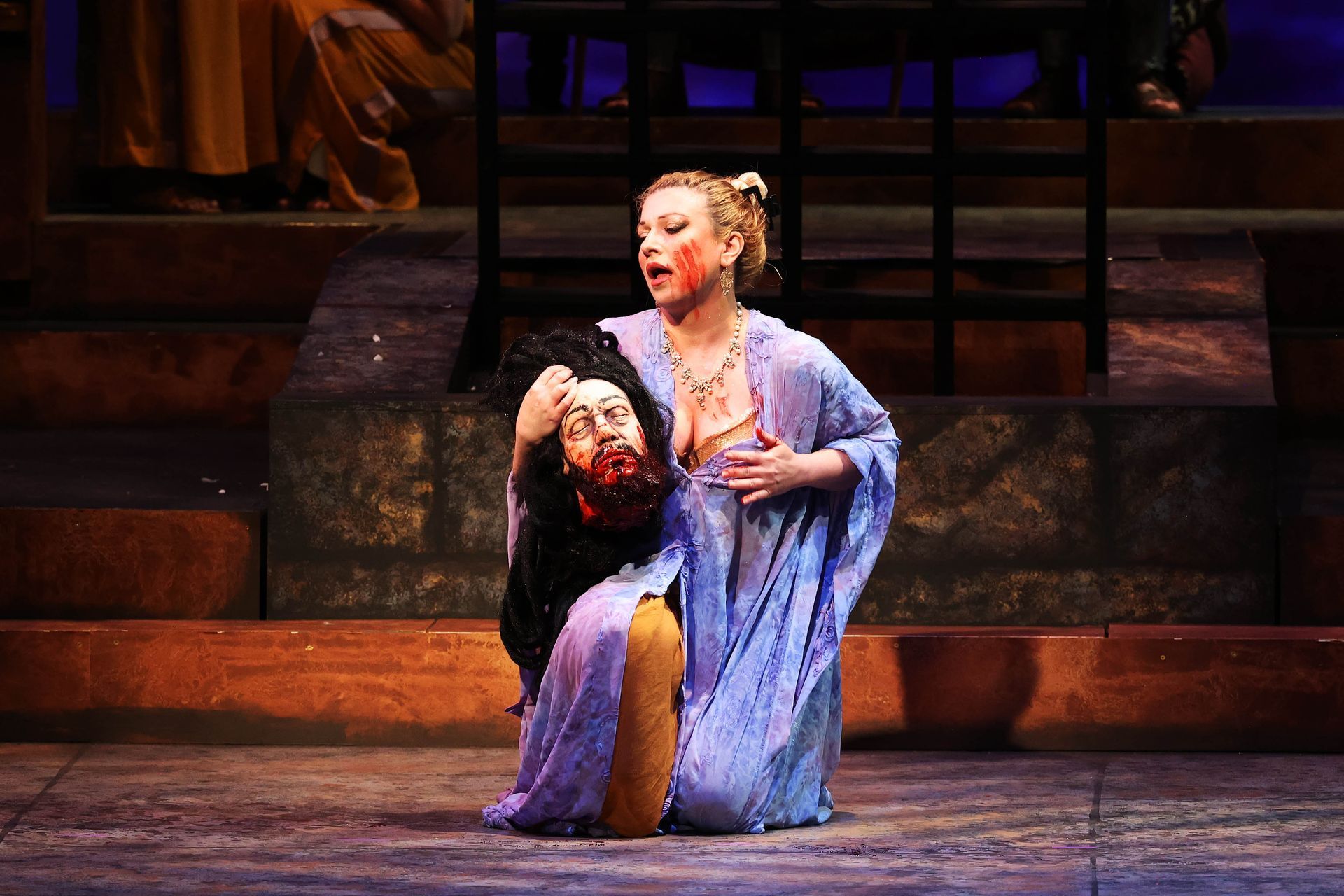
Salomé - Production image

"...a production soaring to the heights musically, visually, and dramatically."

Eddie Reynolds - TheaterEddies

"Led by a sizzling soprano in the central role, exquisite supporting players throughout, and a sonorous and responsive orchestra conducted by Jose Luis Moscovich, West Bay Opera offers a compelling rendition of this powerful work."

Victor Cordell - Berkshire Fine Arts

"West Bay Opera’s ‘Salome’ takes audiences on a wild, wild ride..."

Michael J. Vaughn -The Almanac


Salome

by  Richard Strauss

Libretto by Hedwig Lachmann

translated from Oscar Wilde's French language play Salomé


Opera in one act

In German with projected English titles


Friday, Feb 13 - 7 p.m.

Sunday, Feb 15 - 2 p.m.

Saturday, Feb 21 - 7 p.m.

Sunday, Feb 22 - 2 p.m.


at the Lucie Stern Theatre

1305 Middlefield Rd., Palo Alto, CA 94301


Performances are 1 hr 50 min long with no intermission

FREE Preview with Piano

Thursday, Feb 5, 2026 - 7:00 p.m.

at the

Holt Building

221 Lambert Ave, Palo Alto, CA 94306


Buy Tickets

About

Salome


Background and Synopsis


World Premiere:  Königliches Opernhaus (now Semperoper) - Dresden, Germany

December 9, 1905 


WBO Premiere:  May 26, 2017

Pictured: Interior view of the Semperoper


Strauss composed Salome after seeing Max Reinhardt's staging on the Oscar Wilde play, which used Lachmann's German translation, in Berlin in 1902. Not unlike Samson et Dalila, it is also a work about feminine power, eroticism and ritual sacrifice, and, though it reached the stage three decades after Samson et Dalila, it initially encountered similar censorship and social rejection. Eventually, it made its way into the standard repertoire.


 Although the grit and violence components are the most tantalizing, Salome is actually a work of great beauty and great dramatic power.  Salome's rejection of her stepfather's sexual advances, her infatuation with Jochanaan (John the Baptist) and her choice to have him beheaded are steps in a story that develops inexorably, and Strauss' fantastical, highly romantic and atmospheric score makes every step along the way seem inevitable.


Synopsis


The story takes place in the first century CE, during Jesus' lifetime, after the Roman conquest of the Levant. Herod Antipas has been anointed Tetrarch of Galilee and Perea. He has divorced his first wife and married Herodias, who was formerly married to his brother. Herod lusts after Herodias' teenage daughter Salome. The opera opens on the terrace of Herod's palace in Tiberias, outside the banquet hall where Herod is entertaining Roman dignataries.

Jochanaan (John the Baptist) has been imprisoned in the cistern for criticizing Herod's marriage to Herodias. Salome flees the banquet and Herod's lustful gaze, and as she enters the terrace she hears Jochnaan's voice cursing her mother. She takes an interest in him and persuades one of the guards to bring him out of the cistern. She is instantly infatuated with him, commenting on his skin, his hair and his lips, and begging him for a kiss. But Jochanaan rejects her, calling her the daughter of Sodom. Herod comes out, followed by his entourage and tries to engage Salome, inviting her to drink, eat and rest, but she rebuffs him. Finally, he begs her to dance for him. She agrees after he promises to give her whatever she desires. She dances the Dance of the Seven Veils, after which she demands as her reward the head of Jochanaan. Herod, who recognizes in Jochanaan a holy man, is afraid to harm him and tries to persuade her with extravagant gifts but she insists, and he eventually agrees. She is handed the severed head. In a chilling final scene, she sings a long monologue about the meaning of love and power. Eventually she kisses the bloody lips and boasts that she has kissed Jochanaan even though he rejected her. Shaken by the spectacle, Herod orders the soldiers to kill her on the spot.


Buy tickets

Creative team


José Luis Moscovich - Conductor

Richard Harrell - Stage Director

Daiane Lopes da Silva - Choreographer

Peter Crompton - Set and Projection Designer

Callie Floor - Costume Designer

Danielle Ferguson - Lighting Designer

David Gillam - Makeup and Wig Designer

Giselle Lee - Sound Designer


Pictured: floor plan for a set design by Peter Crompton 

for the 2016 production of Salome at WBO

Bios and Photos Buy tickets

Cast


Salome - Joanna Parisi*

John the Baptist - Nathaniel Sullivan*

Herod - Will Upham*

Herodias - Laure de Marcellus

Narraboth - Brian Skoog*

Page - Valérie Filloux*

First Soldier - Isaiah Musik-Ayala

Second Soldier - Casey Germain

1st Jew - Arthur Wu

2nd Jew - Carmello Tringali

3rd Jew - Caleb Alexander*

4th Jew - Michael Orlinsky

5th Jew - Kirk Eichelberger

1st Nazarene - Casey Germain

2nd Nazarene - Caleb Alexander

Cappadocian - Kirk Eichelberger

Slave - Lindarae Polaha


* First appearance with WBO

Bios and Photos Buy tickets
Photo: Otak Jump

Orchestra


Dian Zhang, concertmaster *

Violin I · Sofia Fojas, Virginia Smedberg, Kate Wahl

Violin II · Lisa Zadek, Frida Pukhachevsky

Gulnar Spurlock, Julian R. Brown 

Viola · Andrew Lan, Mark Fish, Donny Lobree

Cello · Janet Witharm, Daniela Gonzalez Siu, Maya Raquel Benyas*

Bass · Marie Laskin

Flute 1 · Michelle Caimotto

Flute 2/Piccolo · Vivian Boudreau

Oboe 1 · Dane Carlson

Oboe 2/English Horn · Troy Davis

Bassoon 1· Amy Duxbury

Bassoon 2 · Gail Selburn

Horn · Cathleen Torres, Diane Ryan

Trumpet · Richard Leder, Chris Wilhite

Trombone · Michael Cushing

Bass Trombone · Curtis Azevedo

Timpani · Stuart Langsam

Percussion · Norman Peck

Harp · Gennaro Porcaro

~

Orchestra Librarian · Virginia Smedberg

Orchestra Manager · Christy Crews


~


* First appearance with West Bay Opera


Buy tickets
Photo: Otak Jump

Salome - 2026 - Media Gallery

PRODUCTION PHOTOS

Salome -  2026 - Press and Reviews  

Salome -  2026 - Press and Reviews  

  • Read the review by Eddie Reynolds in Theater Eddy's

    Salome

    February 14, 2026 by Eddie Reynolds


    Salome


    Richard Strauss (composer); Hedwig Lachmann (libretto)


    Based on French language play by Oscar Wilde


    West Bay Opera


    Among a number of Biblical women such as Jezebel and Delilah whose names to this day connote evil, betrayal, and manipulation, Salome has always engendered much distain, but also much fascination.  After all, as recorded twice in both the books of Matthew and Mark, it is she who demands the head of John the Baptist be delivered to her by her step-father, King Herod, who had promised her anything she desired up to half his kingdom if only she would dance for him.  


    The scene of a blood-thirsty Salome with John’s severed head has inspired numerous artists like Caravaggio and Titian and in 1893, provided Oscar Wilde enough fodder for a play steeped in seduction, eroticism, and murder.  Having seen Wilde’s controversial play in 1902, Richard Strauss in conjunction with librettist Hedwig Lachmann immediately began to compose an opera that soon became more famous and more performed than Wilde’s original work — a demanding one-act that West Bay Opera now opens in a production soaring to the heights musically, visually, and dramatically.


    Surely few roles in opera require as much from the lead as does Strauss’ demands on this work’s Salome.  The requirements of vocal range that stretch from a soprano’s top notes to a contralto’s depths, the demands of vocal power and stamina, the call for the grace and limberness of a ballerina, and the absolute need to be stellar in a wide range of acting abilities must narrow the field as any artistic director is seeking a Salome.  In Joanna Parisi, West Bay’s José Luis Moscovich hit the jackpot because she rates a ten-out-of-ten in each of those categories.


    Even before her initial appearance on the stepped terrace of Herod’s columned palace, her Salome is center stage as the palace guard captain, Narraboth (Brian Skoog) sings in compelling and expressive tenor, “She is like a dove who has lost its way … like a white rose in a silver mirror.”  Upon her entrance and her hearing a mysteriously rich and masculine voice from somewhere in the depths of a locked and gated cistern, Salome immediately entices the adoring Narroboth to release the cellared prisoner whom she is told is a prophet that her step-father and Tetrarch (Herod the ruler) has ordered no one to see or speak.  With increasingly coyness and beautiful notes dripping in enticement, Salome wins; and we get our first of many proofs of Joanna Parisi’s vocal and acting prowess. 


    When the dazed, bearded, and bare-chested Iokanaan (known by us as John the Baptist) emerges in only a loin cloth and long, black hair much disheveled, Nathaniel Sullivan’s rich and rigorous baritone sounds out condemnations of Herod and especially his wife, Herodias, who was once married to Herod’s brother before he was murdered by the king.  Even knowing Iokanaan sings of her mother’s sins, Salome becomes hypnotically enthralled with this strange man of God, singing in increasingly resounding, ringing voice as she longs to touch his body, caress his hair, and kiss his lips.  


    The more she wants his body “white as ivory,” hair like “clusters of grapes,” or mouth “redder than roses,” the more Iokanann rejects her, his now singing with evangelical strength his warnings she must seek “the son of Galilee” for her salvation.  Each rejection by him first leads Salome to turn her compliments into insults, only quickly to sing of her renewed love and desire.  Not only with a voice that elevates in both pitch and volume to incredible heights but also with simultaneous attempts to conquer Iokanaan with wildly grasping arms and desperate attempts to overcome him one way or another does Joanna Parisi continue to amaze.


    And as the opera’s lurid, lascivious story progresses, her Salome only becomes more and more a temptress like none other.  The famous oriental-tinged dance of the seven veils — often relegated in productions to a stand-in dancer — becomes another avenue for this Salome to cause us in the audience to gasp in dropped-jaw at the near-animal-like being she becomes as she at first sensuously, then lustfully, and finally lasciviously removes each veil and swoops around, crawls toward, and rolls in front of her wide-eyed, clearly aroused step-father .  That sequence is only eventually topped by her final act of literally making love to a severed, bleeding head — all the time now singing with a voice fiery and fierce — a voice dripping in evil even while incredibly stunning in power and quality.


    So clear it is that the apple does not fall far from the tree as we watch Laure de Marcellus’ depiction of Salome’s mother, Herodias.  With a mezzo-soprano that can send chills down one’s back as she snarls her dislike of Iokanaan and as she eggs on her daughter not to give in to Herod’s offers of riches in lieu of the prophet’s head, her Herodias may be even more evil than the daughter she so watches with creepy, triumphant pride as Salome caresses the severed head.  Kudos goes to this staggeringly vile in vocal tones, searing eyes, and tight smirks, Herodias.


    As Herod, Will Upham brings a tenor voice that cuts through the air with an edge along with a demeanor that is less that of a powerful ruler, but one more of a superstitious, near mad-man who has no boundaries when it comes to his lust for the forbidden — be it once his brother’s wife or now, his step-daughter.  While his performance is overall admirable, his Herod does not quite rise to the same level as the portrayals of Iokanaan, Herodias, or Salome.


    While this story full of deadly tragedy worthy of any that Shakespeare ever wrote does not have much of the Bard’s humor that he normally inserts via gravediggers, traveling actors, or bumbling servants, a quintet of singing, quarreling Jews provides a few, short minutes of relief as they debate vigorously how good or terrible is God and how holy or not is Iokanaan.  Among them, Kirk Eichelberger’s bass excellence is particularly memorable.


    Equal at least to any one role of the outstanding principals of the evening is the superior performance of the thirty-four-piece orchestra.  Time and again, the temptations, the anger, the coming acts of evil, and the sheer madness of the stage are sounded with shattering might, with cinema-like scope, and with complex depth by the musicians surrounding the stage in three positions and conducted so vigorously by José Luis Moscovich.


    Much credit must go also to Stage Director Richard Harrell and to Choreographer Daiane Lopes da Silva for their creative and boundary-busting inspirations that shaped the performances of all, but especially of the evening’s Salome.  Peter Crompton’s richly colored scenic projections of a moon and sky whose character transforms from idyllic to hellish as the events progress enhance greatly the atmosphere surrounding the palace court he also designed.  Callie Floor’s costumes often remind one of the pictures that many of us as children saw in the family Bible in our parent’s home .  Finally, the lighting designed by Daniele Ferguson is an array of mood-setting shadows, startling spotlights, and foreboding storm clouds that provide a capstone for the creative team’s total scene-setting effort.


    West Bay Opera’s Salome is an incredibly impressive accomplishment for any opera company, especially one that produces on a smaller, more intimate stage than most and one located in the suburbs.  Having said that and having praised so many aspects of this production, I must admit that Salome for me is not particularly an opera I would seek to see soon again.  The final, blood-dripping scene of Salome and the severed head is disturbing and seems to last forever.  There is also little uplifting that I find to take away from the evening.  It is truly a gruesome tale.  But that said, in this West Bay Opera production, Salome is told with a score performed magnificently glorious and with demands more than met by the title lead in ways mind-boggling to behold and to hear.


    Rating: 4 E


    Salome continues February 15, 21, and 22, 2022 in a ninety-five-minute production (no intermission) in production by West Bay Opera at Lucie Stern Center, 1305 Middlefield Road, Palo Alto.  Tickets are available online at https://www.wbopera.org/ or in person/by phone at the box office Monday – Friday 1-5 p.m. at 221 Lambert Avenue, Palo Alto (650-424-9999).


    https://theatreeddys.com/2026/02/salome.html


  • Read the review by Barbara Keer in Splash Magazine

    Salome Review: West Bay Opera at its Most Powerful

    Barbara Keer·Global & Regional On-Stage·February 19, 2026·4 min read


    Salome is coincidentally being performed by two of my favorite opera companies, one very large and the other, intimate.  Being a transplant from Chicago, I have been a fan of the Lyric Opera of Chicago for many years before moving west and discovering the West Bay Opera, jewel that it is. I am always impressed with how special it is to attend a West Bay Opera performance, each a unique experience when one is welcomed by WBO’s General Director, José Luis Moscovich. This is West Bay Opera’s 70th year. 


    Salome by Richard Strauss, Libretto by Hedwig Lachmann, translated from Oscar Wilde’s French language play is an opera in one act (one hour and fifty minutes – no intermission) presented in German with projected English titles.


    What to watch for: A fully staged production of Richard Strauss’ masterpiece opera Salome. The opera reflects the homonymous play by Oscar Wilde on which it is based: a Victorian, orientalist take on a Biblical story. Herod, the puppet king anointed by the Romans, lusts after his second wife’s teenage daughter, Salome. Herod’s lustful stare makes Salome uncomfortable. She flees the banquet table and finds herself on the palace terrace. She hears the voice of John the Baptist, imprisoned in the underground cistern. Fascinated by his voice, she manipulates the guards into letting the prisoner come up and speak with her. She is instantly smitten with him, but he rejects her as the daughter of an unworthy woman. Herod comes on to the terrace looking for Salome and eventually convinces her to dance for him, after promising her that in exchange he’ll give her anything she wants. She dances for him and then demands as her reward the head of John the Baptist on a silver platter. The head is presented to her. In a macabre final scene, she observes that there is a bitter taste on his lips, the taste of blood, or perhaps the taste of love, and that the mystery of love is deeper than the mystery of death. Shocked by her behavior, Herod orders her killed on the spot.


    It is interesting that the name, Salome is a derivative of Shalom, meaning peace.  Clearly there is nothing peaceful about this Salome.  The role is demanding on every level.  Salome sings for a large part of the opera, acts, dances, is provocative, and this Salome has hair that is amazing.  Kudos to soprano Joanna Parisi who was remarkable.


    Jochanaan (John the Baptist) who was imprisoned in the cistern for criticizing Herod’s marriage to Herodias, was performed by Baritone Nathaniel Sullivan. Placed in a “cistern” on a level below the stage, his beautiful voice reached the audience loudly and distinctly.  Later, the audience learned from WBO’s General Director, José Luis Moscovich who conducted to the 30-piece orchestra (larger than usual), that he assisted the amplification of Jochanaan’s voice with the creation of a cardboard “bull horn”.  The sound quality was remarkable.  Come to hear it!


    There are four, count them four tenors, two of them are Will Upham as Herod and tenor Brian Skoog as Narraboth. And don’t forget the famous Dance of the Seven Veils, choreographed by Daiane Lopes da Silva. Cheering Salome on and possibly setting her up is her mother, Herodias enacted by mezzo-soprano Laure de Marcellus. Richard Harrell stage-directed Salome, with great skill.


    While the sets and projected images by Peter Crompton always add richness, atmosphere and interest to the productions, this was, by far the most intricate and creative stage creation that I have seen, so far.  And, again Callie Floor’s costumes are always a joy to see and right on in consistency with the topic.  She outdid herself! The lighting design by Danielle Ferguson, projection systems design by Frederic O. Boulay and sound design by Giselle Lee carried the voices and the story forward.


    As you experience this opera you may wonder why it is so outrageous. I found this explanation but no one to give credit for this “Richard Strauss was motivated to write Salome (1905) by a desire to create a modern, psychologically intense musical drama, sparked after seeing Max Reinhardt’s 1902 Berlin production of Oscar Wilde’s play, which he felt “cried out for music”. He aimed to shock audiences, explore dark themes of sexual obsession, and push operatic boundaries, using the provocative, decadent, and Symbolist narrative to break from traditional, conservative conventions.” And thus, he made his reputation.


    This fantastic production will take place again on Saturday, February 21, at 7:00 p.m. and Sunday, February 22, at 2:00 p.m. at the Lucie Stern Theatre, 1305 Middlefield Road, Palo Alto, CA.


    https://splashmags.com/2026/02/salome-review-west-bay-opera-at-its-most-powerful/


  • Read the review by Victor Cordell in Berkshire Fine Arts

    Salome

    West Bay Offers Solid Production of Strass's Classic

    By: Victor Cordell - Feb 16, 2026

    2 / 6


    To those unfamiliar, opera may seem a staid performance art for the aged, stuffy elite. Of course, aficionados know opera as a hotbed of intrigue, betrayal, and all manner of violent death from murder to war. And opera played such a profound role in Europe’s culture, especially in the 19th century, that state and local censors ensured that salacious and potentially disruptive political themes didn’t make it to the stage.


    In 1905, with somewhat more relaxed censorship, Richard Strauss’s adaptation of Oscar Wilde’s play Salome premiered. In his home country of Austria, however, Vienna’s censor forbade it, so that the premiere had to be given in Graz, albeit, with luminaries such as Puccini, Mahler, Berg, and Schoenberg in attendance. It was initially banned in Britain, at the Met, and elsewhere, but its successes, particularly in Germany, eventually opened doors.


    The ban-birds were offended by the vulgarity of the script, which is decadent even within the context of opera. A summary of the plot, which extrapolates fancifully on the Biblical story, is that the psychopathic Salome’s lust for Iokanaan (John the Baptist) is unrequited and spurned, so she demands that she be brought his head. Her dictate is fulfilled. The horror of the murder was enough to offend censors in Christian countries, and the erotic “Dance of the Seven Veils,” which precipitates the beheading, added to the calls for redaction or rejection. And though the music wasn’t a basis for censorship, its dissonant violence challenged accepted norms.


    Led by a sizzling soprano in the central role, exquisite supporting players throughout, and a sonorous and responsive orchestra conducted by Jose Luis Moscovich, West Bay Opera offers a compelling rendition of this powerful work. While it is a traditional production with an attractive period set and costumes, you can already tell, that doesn’t mean it’s tame.


    More than most operas, Salome rises and falls on the performance of one artist, the title character, who dominates the action once she makes her appearance. And Strauss’s music places huge demands on a Salome’s vocal strength, endurance, and range. In her Bay Area debut, Joanna Parisi gives an enthralling performance with a voice that reaches the outer limits of what a human is capable of. With house-filling power and crystalline clarity, her Wagnerian dramatic soprano fulfills every need of this role. Yet, her performance here and her history of diverse roles reflect the young, talented artist’s lyric abilities as well.


    In this story, the married but feckless King Herod (steadfast tenor Will Upham in an ambiguous and ambivalent role) yearns for his stepdaughter, the 15-year-old Salome, who disdainfully rejects his approaches. But when he asks her to perform the dance of the seven veils, the petulant teen agrees if he will grant her a wish.


    Of course, Herod is shocked when he learns of her horrific wish, but the question is - what does his acquiescence say about the character of the king when he reviles the command that he gives? Or what of Herodias (the formidable mezzo Laure de Marcellus who sometimes goes toe-to-toe with Parisi in the high, harsh notes), his bloodthirsty wife and mother to Salome, who revels in the debauchery?


    In some productions, the singer of Salome also performs the dance, while in others, a preferably lookalike dancer substitutes. In this case, Parisi sashays sexually but is also joined by dancer Lydia Lathan, who acts as an attendant in the interesting choreography which plays to orchestral music that reveals both Arabic and Viennese strains. While Parisi is not as smooth or nimble as Lathan, she is most effective when provocatively twirling her unfurled hip-length blond hair and writhing on the floor.


    Parisi’s dramatic acting excels in the closing sequences before the beheading when it is unclear whether she regrets her wish and after in her mad scene. Conversely, some early missteps with curious actions and posturing by her and others seem somewhat comic and break the dramatic trance.


    Another potential staging issue concerns the offstage singing of Iokanaan, as any singing behind the scenes can get lost. To begin with, Nathaniel Sullivan as Iokanaan has a strong and agile voice and when bedecked for it, fits the part well (i.e., in real-life he appears more a Clark Kent, but he transforms into a primitive-looking Superman type). The solution is that rather than singing from the wings, he sings from the cistern in the middle of the stage in which he is imprisoned. He also uses a homemade, unamplified megaphone, so that he comes through loud and clear.


    Salome is structured as a stage tone-poem, with no set pieces, yet some sequences are separable such as the stunning and energetic duet when the religious Iokanaan emerges from the cistern to Salome’s lascivious appraisal of him and the vigorous quintet of five Jewish men. While the music is often harsh and dissonant, it is tonal and often in the Romantic vein. Strauss also uses a number of identifying leitmotifs, as well as some that are murky.


    This opera was Strauss’s first success and began a string of hits. In 90 minutes or so, it is compact dramatically and musically, and West Bay’s production is well worth seeing, with some memorable performances.


    Salome, composed by Richard Strauss with libretto by Hedwig Lachmann and based on Oscar Wilde’s play of the same name, is produced by West Bay Opera and performed at the Lucie Stern Theatre, 1305 Middlefield Road, Palo Alto, CA through February 22, 2026.


    https://berkshirefinearts.com/02-16-2026_salome.htm

  • Read the review by Michael Vaughn in The Almanac/Palo Alto Weekly

    Review: West Bay Opera’s ‘Salome’ takes audiences on a wild, wild ride


    Richard Strauss’ spin on biblical tale is bursting with inventive music and otherworldly performances


    by Michael J. Vaughn

    February 18, 2026 4:50 pm


    West Bay takes one of the more provocative creations in opera and gives it a grand treatment. The resultant performance resembles an acid trip married to an absurdist horror film with a great soundtrack. It’s a wild, wild ride.


    Much of the wildness originates in Strauss’s score, which flies through key changes and uses dissonance and atonal passages that were, in 1905, far ahead of the curve. Conductor José Luis Moscovich and a larger-than-usual orchestra (literally packed into the wings) handled the challenge with aplomb, particularly in Strauss’s inventive use of woodwinds. The visual I would offer is a gurgling pot of musical magma, bursting forth at regular intervals.


    And there’s a lot to burst forth about. Created from Oscar Wilde’s play of the same name about biblical characters, the drama focuses on the evil king Herod, who openly lusts for his stepdaughter Salome, and is willing to do just about anything — including, say, executing a left-wing agitator — to feed his unquenchable desires. (I’m sorry, does this seem familiar?)


    The opera is hugely dependent on its title character, and in this category West Bay has hit the jackpot. Joanna Parisi brings a dramatic soprano so vibrant and powerful it almost seems otherworldly. At the same time, she proves capable of pulling back to sterling pianissimos, perhaps during an intimate rendezvous with a severed head.


    Her presence, also, seems extraterrestrial, fueled by Salome’s sociopathic desires. The Dance of the Seven Veils is a huge demand for any opera singer; Parisi and choreographer Daiane Lopes da Silva devise a dance that makes use of Parisi’s natural appeal and quirky moves that match her character’s insanity. At one point, she drapes her voluminous blonde hair across the stage floor and pokes her hands through it like puppets. It sounds just plain weird, but it’s an arresting image. (The nudity factor is somewhere around high PG-13.)


    A small distraction to Parisi’s performance is her habit of swimming into her entrances, as if she were using her body to count off beats. This is generally an opera no-no, but it seems to fit in with Salome’s dancer mentality, and really I don’t care, as long as that magnificent voice keeps coming out.


    Baritone Nathaniel Sullivan offers a strong presence as John the Baptist, known here as Iokanaan. His forceful rejections of Salome’s adorations turn them instantly into insults. As Salome’s mother Herodias, mezzo Laure de Marcellus conveys all of the queen’s desperate frustrations, watching her victories dissolve in the wake of her husband’s insane lust. This builds to a stunning forte and then a shout that silences the court and sends a thrill through the audience. (Strauss’ score is so packed with sound that most of the dramatic moments come in silences.)


    Tenor Will Upham brings a calm, lyric tone to Herod, an effective contrast and a reflection of the king’s weaselly personality. This is most effective when Herod realizes what Salome is asking for as a fee for her dance. Frightened by Iokanaan’s prophecies, Herod tries to moonwalk out of his grandiose offerings.


    The “five jews” scene is a nice bit of comic relief, as Herod’s theological counselors squabble about religion and their prisoner/prophet’s fate. And it was a pleasure to hear Kirk Eichelberger’s resounding bass as the Fifth Jew.


    In general, the opera offers more laugh lines than one might expect. This most often arrives in the form of people acting as if everything is normal when absolutely nothing is normal. Herod slips on the blood next to the body of suicidal captain Narraboth (Brian Skoog) and complains to his staff about their shoddy housekeeping. Given the opera’s origins as a Wilde play, perhaps these morbid laughs shouldn’t be a surprise.


    The best thing about stage director Richard Harrell’s work is that I didn’t really notice it – the story came through as naturally and directly as it should. The projection work by Peter Crompton added greatly to the phantasmagorical feel, phasing the moon from eerie silver to blood red to drifting lumps of lava lamp fire as the evening progressed. As for Iokanaan’s severed head, it was effectively gory but much lighter than a real head. But that’s all right; we were all pretty creeped out.


    The opera is in German with English supertitles, and is a one-act running 95 minutes.


    West Bay Opera presents “Salome” Feb. 21, 7 p.m. and Feb. 22, 2 p.m. at the Lucie Stern Theater, 1305 Middlefield Road, Palo Alto. Tickets are $54-$140., 650-424-9999 or wbopera.org/salome-2026


    https://www.almanacnews.com/ae/2026/02/18/review-west-bay-operas-salome-takes-audiences-on-a-wild-wild-ride/

  • Read the review by Michael Zwiebach in the SF Classical Voice

    West Bay Opera’s Salome is Strong Where it Counts

    Michael Zwiebach on February 23, 2026.


    Among the Bay Area’s small-budget opera companies, West Bay Opera — now in its 70th season — is still at full sail. The company’s success is thanks to its loyal fan base and General Director Jose Luis Moscovich, who has kept the company’s balance sheet steady and its standards high.


    Doing large-scale operas in Palo Alto’s small Lucie Stern Theatre requires some creativity, and tradeoffs are often necessary. But Richard Strauss’s Salome, the company’s second production this season, is a surprisingly good fit. The work doesn’t have a chorus, takes place in one location, and only has a few exits and entrances.


    Saturday’s performance displayed the company’s greatest strength: its casting, which in this case included seven singers new to West Bay Opera, including the three leads.


    Finding a Salome to fill the role’s many demands is nearly impossible, but dramatic soprano Joanna Parisi was a good choice. She boasts a strong voice, capable of sustained exertion at full volume in the upper register, and even the low notes that are sometimes finessed.


    Parisi threw herself into the role, including the dance and the final aria, where she rolled on the ground with a severed head before kissing it. Like many performers of this role, the weight of her voice made her less convincing as a young woman, and she didn’t seize the opportunities Strauss provided to lighten her tone for contrast.


    She attempted to do so when teasing the young captain of the guard, Narraboth, but her phrasing was leaden. She was much better when she first asked for the head of John the Baptist — the vocal change, combined with her delivery and acting, was brilliant.


    A bigger problem was Parisi’s split focus. Because she often looked to Moscovich in the pit, there was little or no eye contact between Salome and the other characters. As a result, drama was lost. In a larger theater, this might be okay, but in the Lucie Stern, it was quite obvious. As a side effect, her phrasing was too careful most of the time. Still, she filled out the soaring lines of her climactic aria with conviction and power to spare.


    Nathaniel Sullivan as Iokanaan (John the Baptist) was excellent, a secure singer with a good voice. Companies usually cast a more resonant, cavernous voice than Sullivan’s lighter baritone, but he has the notes and his sound is open and commanding. His one scene carried a lot of tension and gave the show a jolt of energy.


    Will Upham made a fine Herod, wrapping his clear tenor around the character’s declamatory lines. It’s easy to overplay Herod, especially when made up like a commedia dell’arte character, but Upham didn’t exaggerate. Laure de Marcellus, as Herodias, was also very good and is well known to WBO regulars.


    Of the many excellent supporting players, Brian Skoog deserves a mention for his beautifully sung Narraboth. The first line in a show often indicates where things are heading. From Skoog's first vocal entrance, the audience relaxed. Valérie Filloux (the page of Herodias), Isaiah Musik-Ayala (First Soldier), Kirk Eichelberger (Cappodocian), and the rest of the cast made important contributions.


    The orchestra, using a score reduction for small string band and duple winds and brass, coped well. Moscovich led a performance that moved along and never got too heavy or overwhelming. With so few strings, it’s impossible to give Strauss’s high lines the sonic sheen they’re meant to have, and some of the faster figuration needed more definition. As usual, the non-string players were seated in the wings and, as usual, I expected balance problems, but there were none. Bravo.


    The production, a revival of the one that premiered in 2017, was cleanly directed by Richard Harrell — on a stage this size, sometimes you just need a traffic cop. The functional sets, projections, and costumes were by the usual WBO team of Peter Crompton and Callie Floor, makeup and wigs were by David Gillam, and lighting was by Daniele Ferguson. Daiane Lopes da Silva had some good choreographic ideas and managed Salome’s long dance well.


    But audiences don’t go to West Bay Opera for all of that. It’s a singer’s house, and Moscovich fills it well.


    Michael Zwiebach is the senior editor/content manager for SFCV. He assigns all articles and content, manages the writing staff, and does editing. A member of SFCV from the beginning, Michael holds a Ph.D. in music history from the University of California, Berkeley.


    https://www.sfcv.org/articles/review/west-bay-operas-salome-strong-where-it-counts