Tosca
Giacomo Puccini
Libretto by Luigi Illica and GIuseppe Giacosa
based on the play by Victorien Sardou La Tosca
Opera in three acts
In Italian with projected English titles
Friday, May 22 - 7 p.m.
Sunday, May 24 - 2 p.m.
Saturday, May 30 - 7 p.m.
Sunday, May 31 - 2 p.m.
at the Lucie Stern Theatre
1305 Middlefield Rd., Palo Alto, CA 94301
Performances are 3 hrs long, including 2 intermissions.
FREE Preview with Piano
Thursday, May 14, 2025 - 7:00 p.m.
at the
Holt Building
221 Lambert Ave, Palo Alto, CA 94306
About
Tosca
World Premiere: Teatro Costanzi - Rome
WBO Premiere: Feb 18, 1977
Pictured: Interior view of the Teatro Costanzi (Rome Opera)
Synopsis
The painter Cavaradossi harbors Angelotti, a prisoner escaped from the notorious prison at Castel Sant'Angelo in Rome. Scarpia, Rome's corrupt Chief of Police, suspects that Cavaradossi is hiding Angelotti. Cavaradossi's lover, Tosca, is a young opera singer.
To learn Angelotti's whereabouts, Scarpia has Cavaradossi tortured in his office. Tosca cannot bear it. She gives away Angelotti's hiding place and agrees to sleep with Scarpia in order to save her lover's life. Scarpia promises her a mock execution and writes her a safe-conduct to be able to flee with her lover. In exchange, she will give herself to Scarpia.
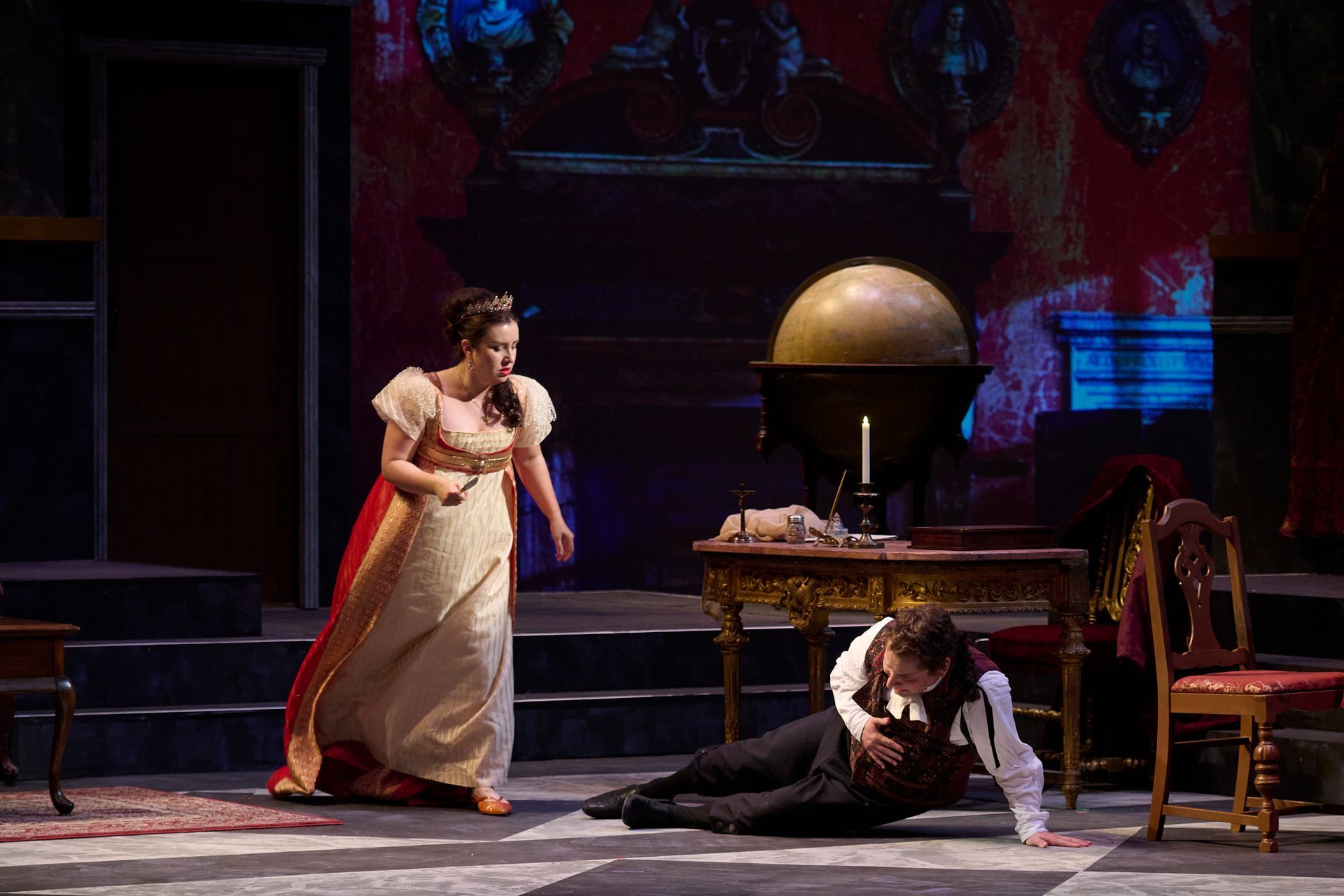
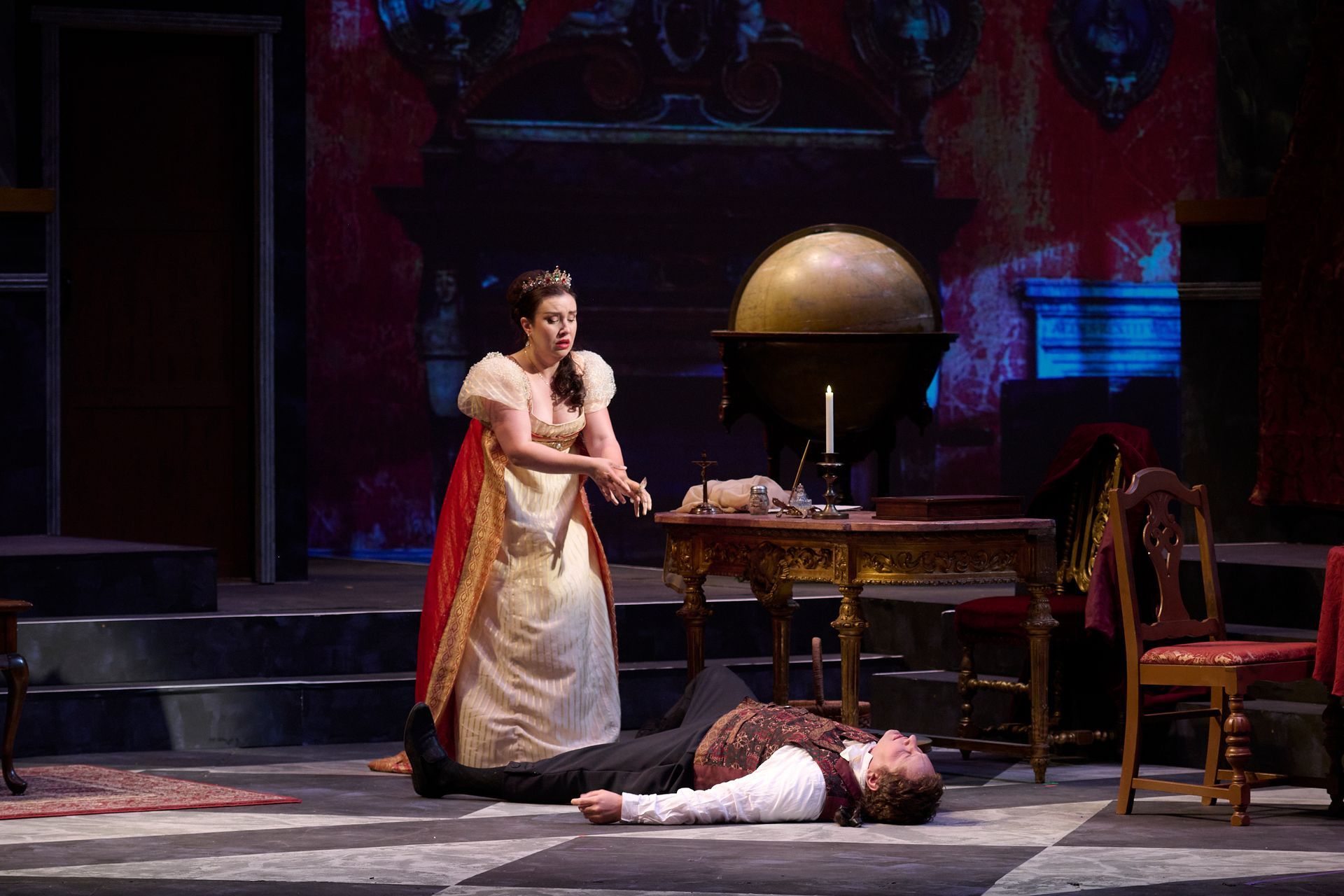
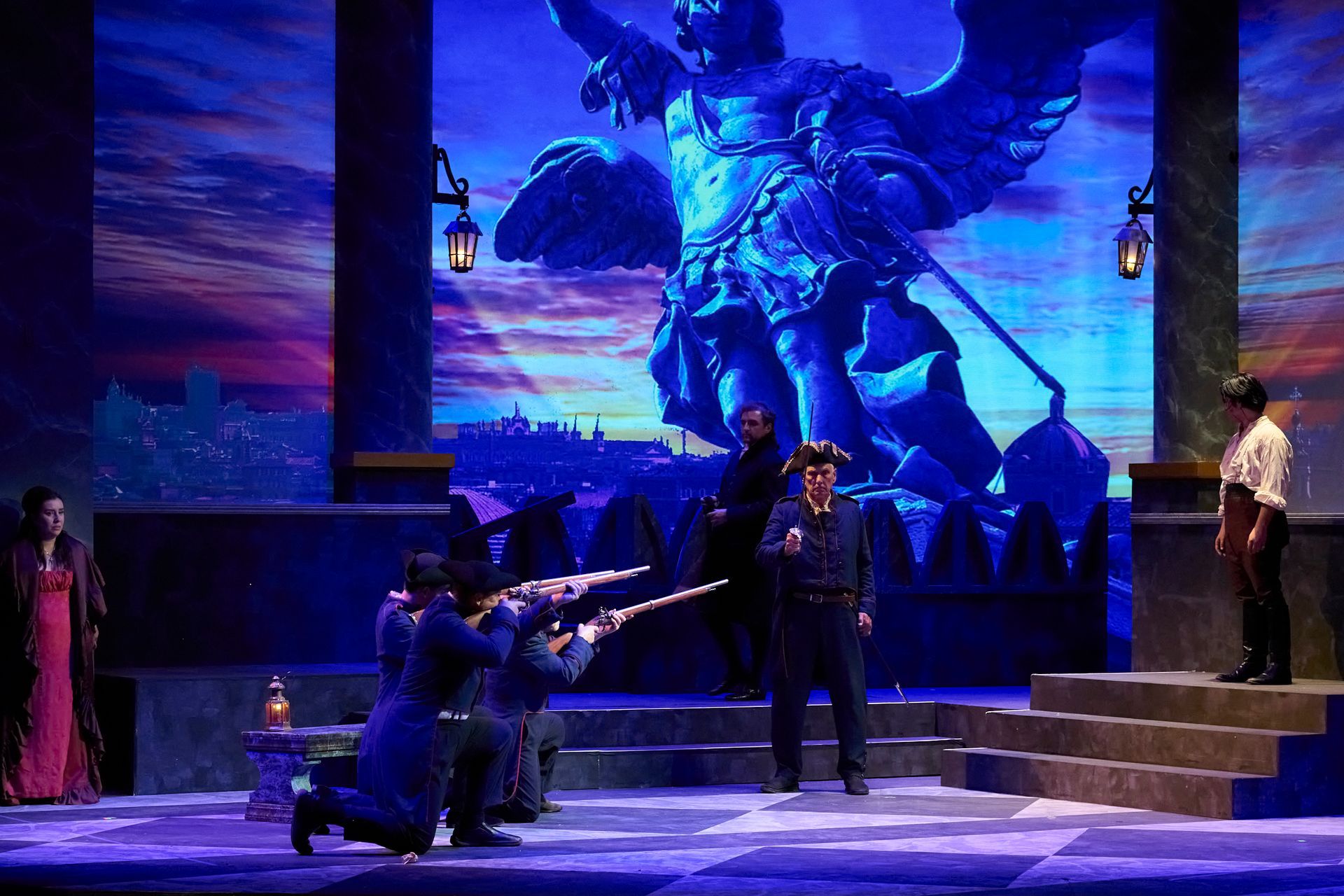
Scarpia signs the safe-conduct and when he turns around to embrace her, she stabs him in the chest with a dinner knife she grabbed from the table. She flees with the piece of paper, eager to rescue Cavaradossi. But Scarpia's promises also turn out to be hollow. Her lover is actually executed at the Castel Sant'Angelo prison. Pursued by guards, who have found out about Scarpia's killing, she jumps to her death from the Castle's tower.
Tosca packs a dramatic force and a level of suspense unsurpassed in the verismo repertoire.
Some Background
The
Tosca story takes place at a particularly turbulent time in Italian history, before Italian unification, in 1800. Abridging the Sardou play to make it viable as an opera meant dropping details, some of which provide needed context. The queen cited by Scarpia is Maria Carolina of Austria, a staunch opponent of the French Revolution and Napoleonic influence. Scarpia is the chief of police for the monarchy, which has come back into power in Naples, with the help of the British, after quashing the Roman republic set up by Napoleon just a couple of years earlier. His job is suppressing dissent. Angelotti, the fugitive in the opening scene, is a former member of the government of the ill-fated Roman republic, and the reason for his imprisonment is that he recognized the queen's confidant as a woman of ill repute he had once met in London, brought into the court in Naples by Lord Nelson. The news of Napoleon's defeat of Melas at Marengo, delivered to Scarpia in the second act, presage the end of the restoration of the monarchy, and the end of Scarpia's power. The news revives Cavaradossi after being tortured, but his vocal support for Napoleon ("Vittoria, Italia!) also seals his fate, as an enemy of the state, justifying the order for his immediate execution. The context in
Tosca is just as large as in Aida or Butterfly, but as with most successful operas, we see it from a personal, intimate perspective, which makes the drama so much more compelling.
Creative team
José Luis Moscovich - Conductor
José María Condemi - Stage Director
Bruce Olstad - Chorusmaster
Peter Crompton - Set Designer
Callie Floor - Costume Designer
Danielle Ferguson - Lighting Designer
David Gillam - Makeup and Wig Designer
Giselle Lee - Sound Designer
Pictured: floorplan for a set design by Peter Crompton
Cast
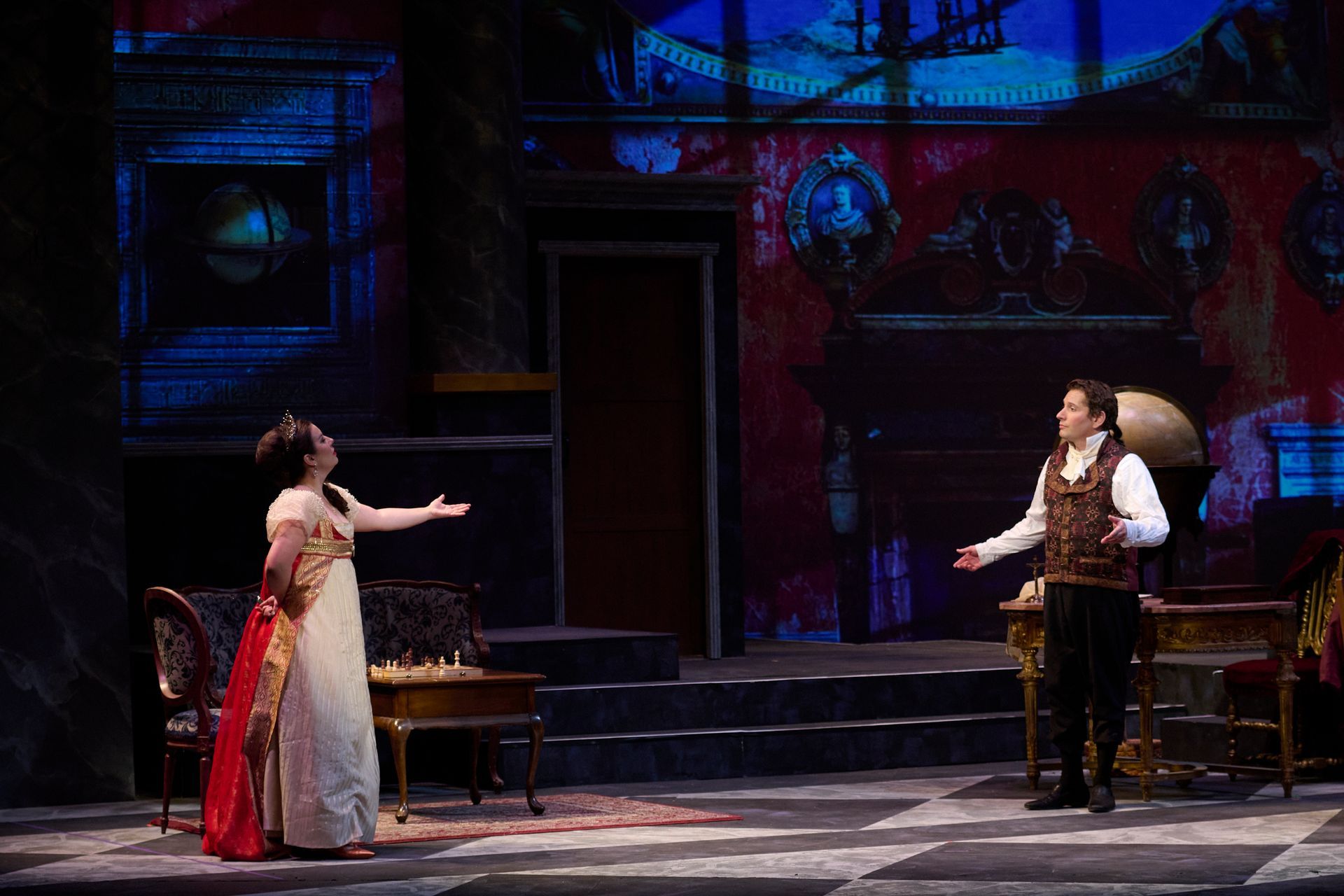
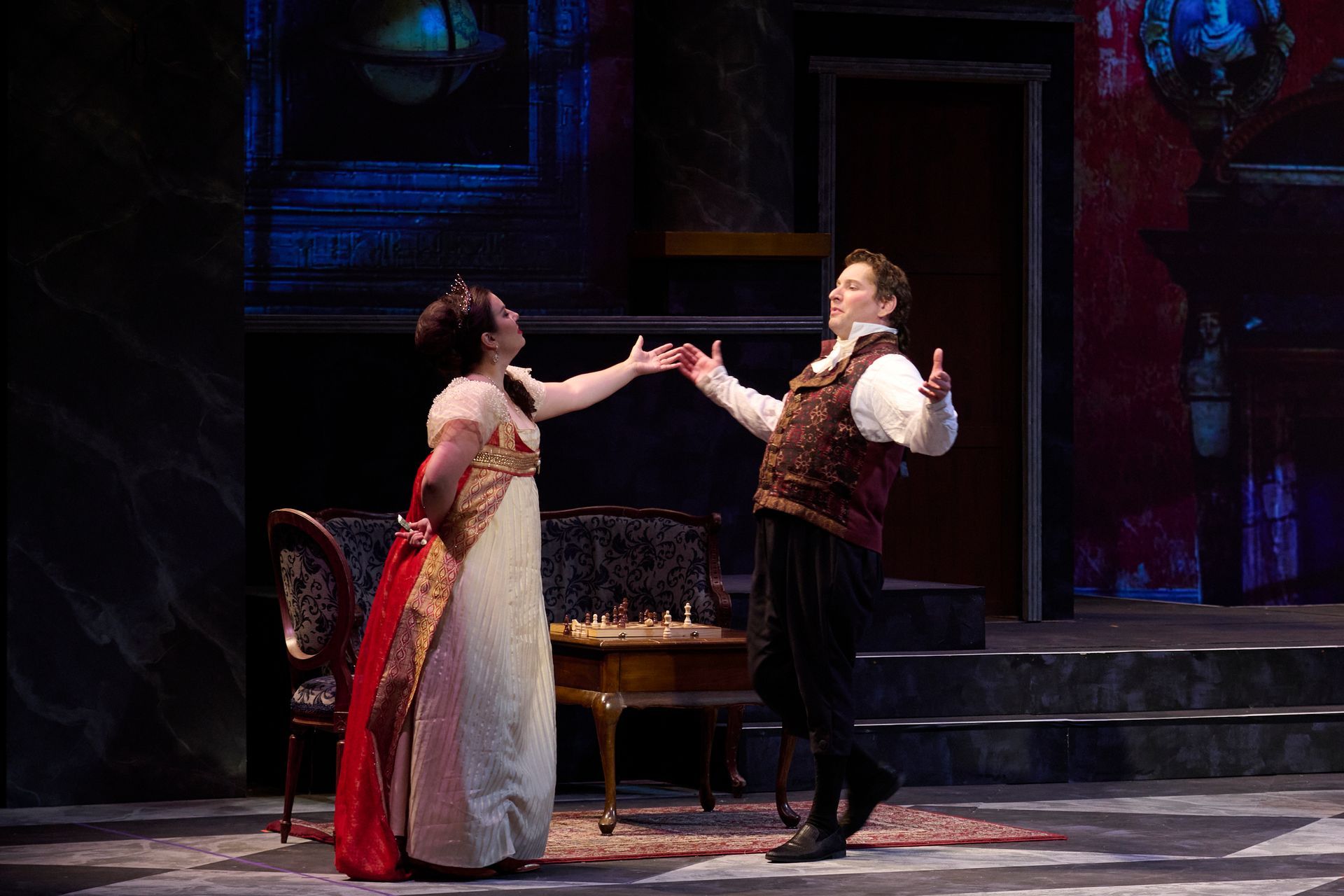
Floria Tosca - Julia Behbudov
Scarpia - Robert Balonek
Mario Cavaradossi - Xavier Prado
Sacristan - Chung Wai Soong
Angelotti - Isaiah Musik Ayala
Spoletta - Caleb Alexander
Sciarrone - Jim Cowing
Jailer - Stephen Miller
Shepherd Boy - Patrick Fallows/Gabriel Herger
Chorus
Bruce Olstad - Chorusmaster
Joanne Bogart - Chorus Manager
Didier Benoit, Joanne Bogart, Yvonne Casillas, JoAnn Close, Cassidy Fink, Michael Good, Lynne Haynes-Tucker, Stephen Kampmeier, Svetlana Kirpu, Stephen Miller, Joanne Newman, Lindarae Polaha, Maria Polyakova, Philip Schwarz. Ashley Shannon, Jessica Shannon, Miles Spielberg, Jo Taubert, Tim Tsang, Yuan Zhu
Altar Boys
Members of the Silicon Valley Boychoir
Julia Simon, Founding Director
Cypress Benevedes, Caleb Chen, Samuel Chen, Patrick Fallows, Gabriel Herger, Luke O'Donnell, Alex Varas
Orchestra
Kristina Anderson (concertmaster),
Violin I · Emily Chiet, Virgina Smedberg, Gulnar Spurlock
Violin II · Lisa Zadek, Frida Pukhachevsky, Judy Kmetko, Julian R. Brown
Viola · Andrew Lan, Alessandra Aquilanti, Donny Lobree
Cello · Janet Witharm, Maya Raquel Benyas, Thomas Shoebotham
Bass · Christy Crews
Harp · Gennaro Porcaro
Flute · Michelle Caimotto
Oboe · Meave Cox
Clarinet · Kyle Beard*, Karen Sremac
Bassoon · Amy Duxbury
Horn · Cathleen Torres, Diane Ryan
Trumpet · RIchard Leder
Bass Trombone - Jason Hebert*
Timpani · Don Baker
Percussion · Norm Peck
Keyboards · Jonathan Erman
~
Orchestra Librarian · Virginia Smedberg
Orchestra Manager · Christy Crews
* First appearance with West Bay Opera
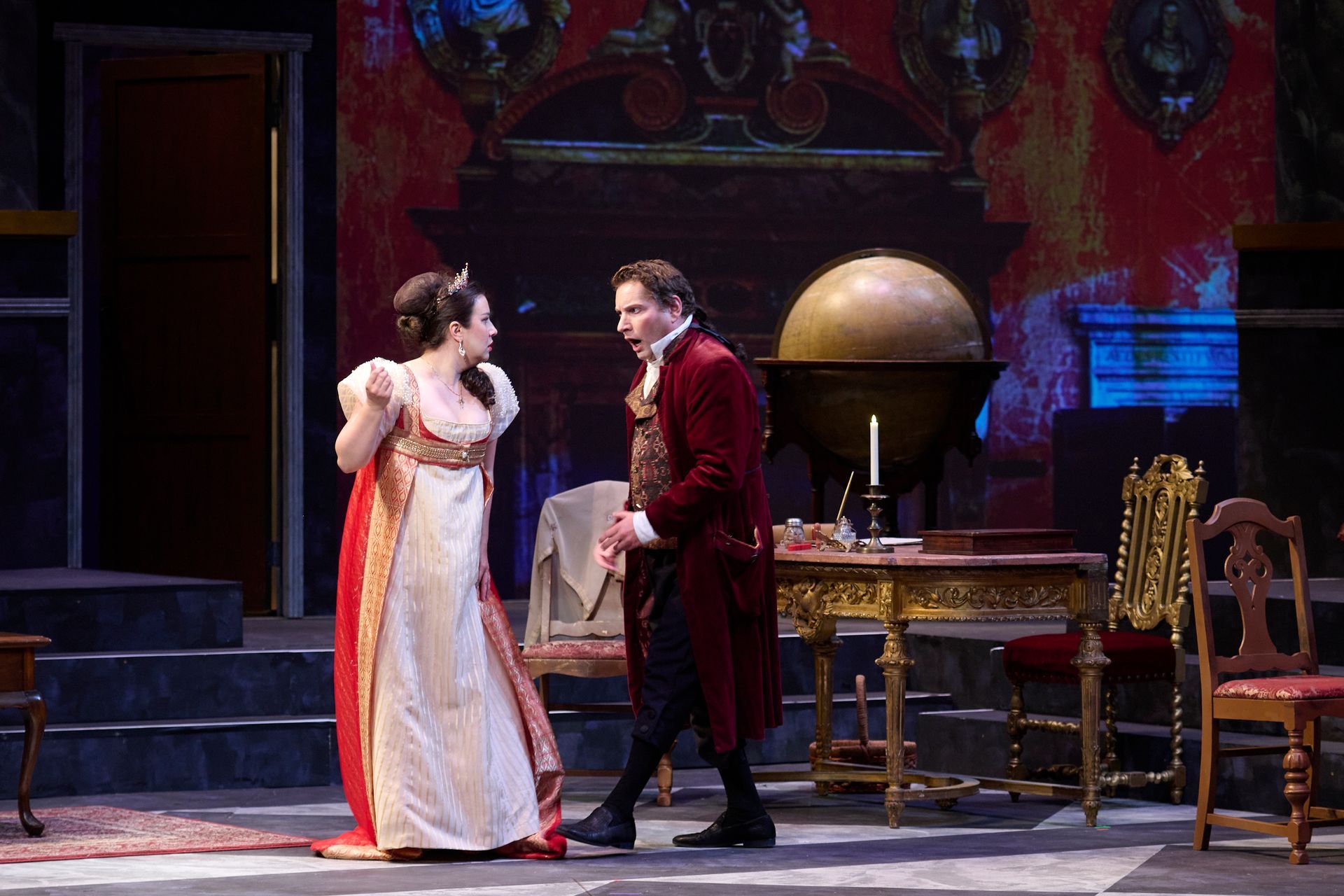
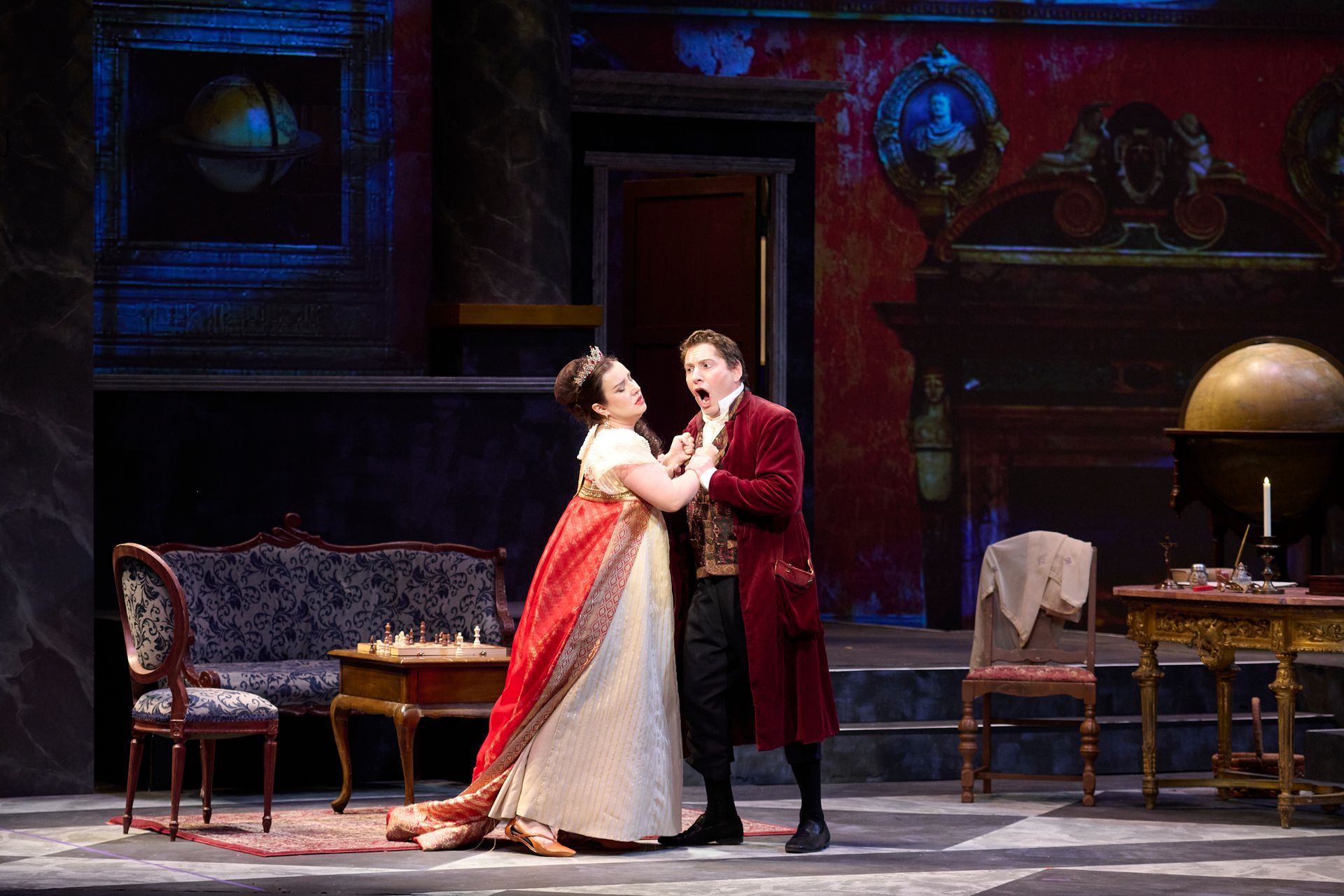
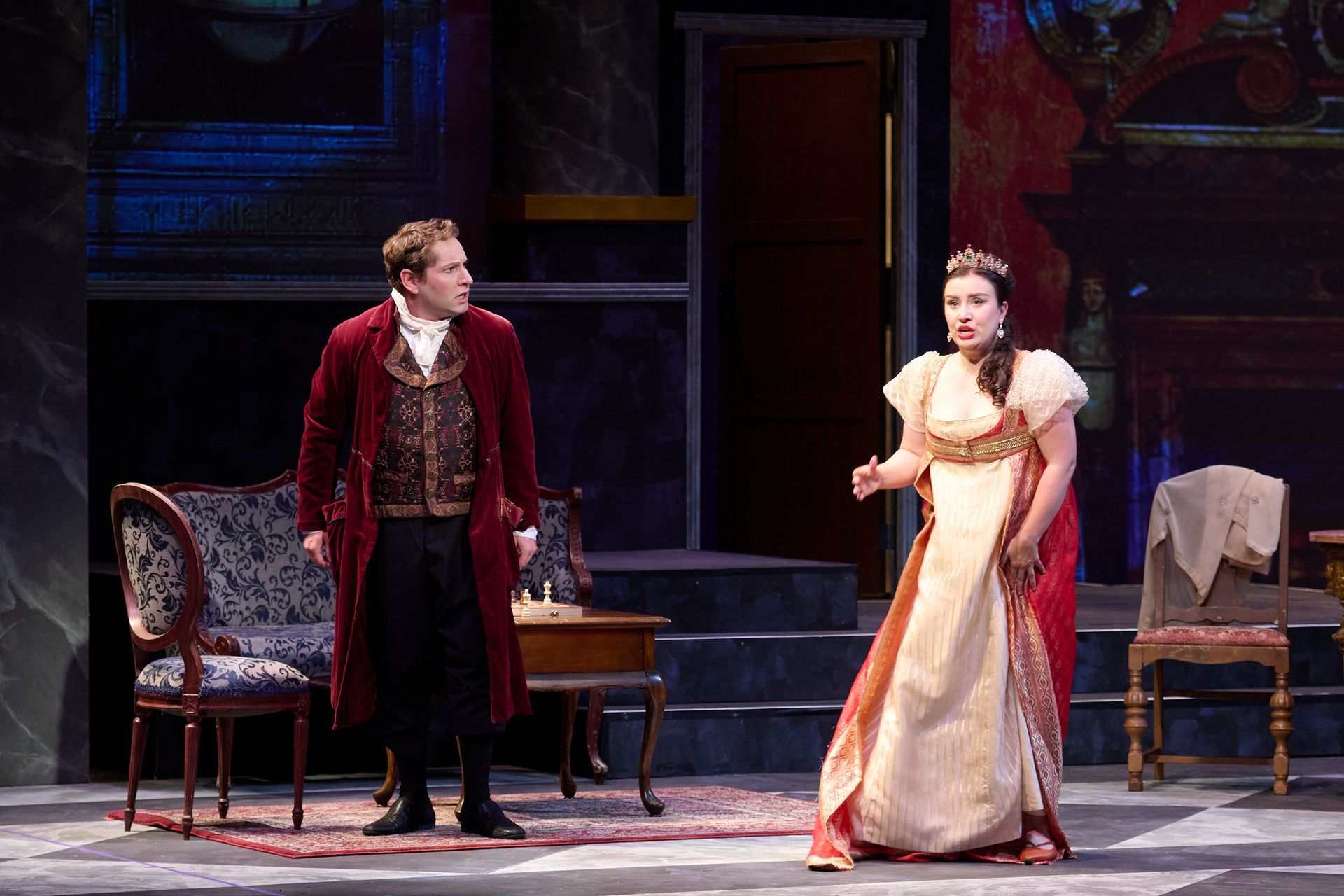
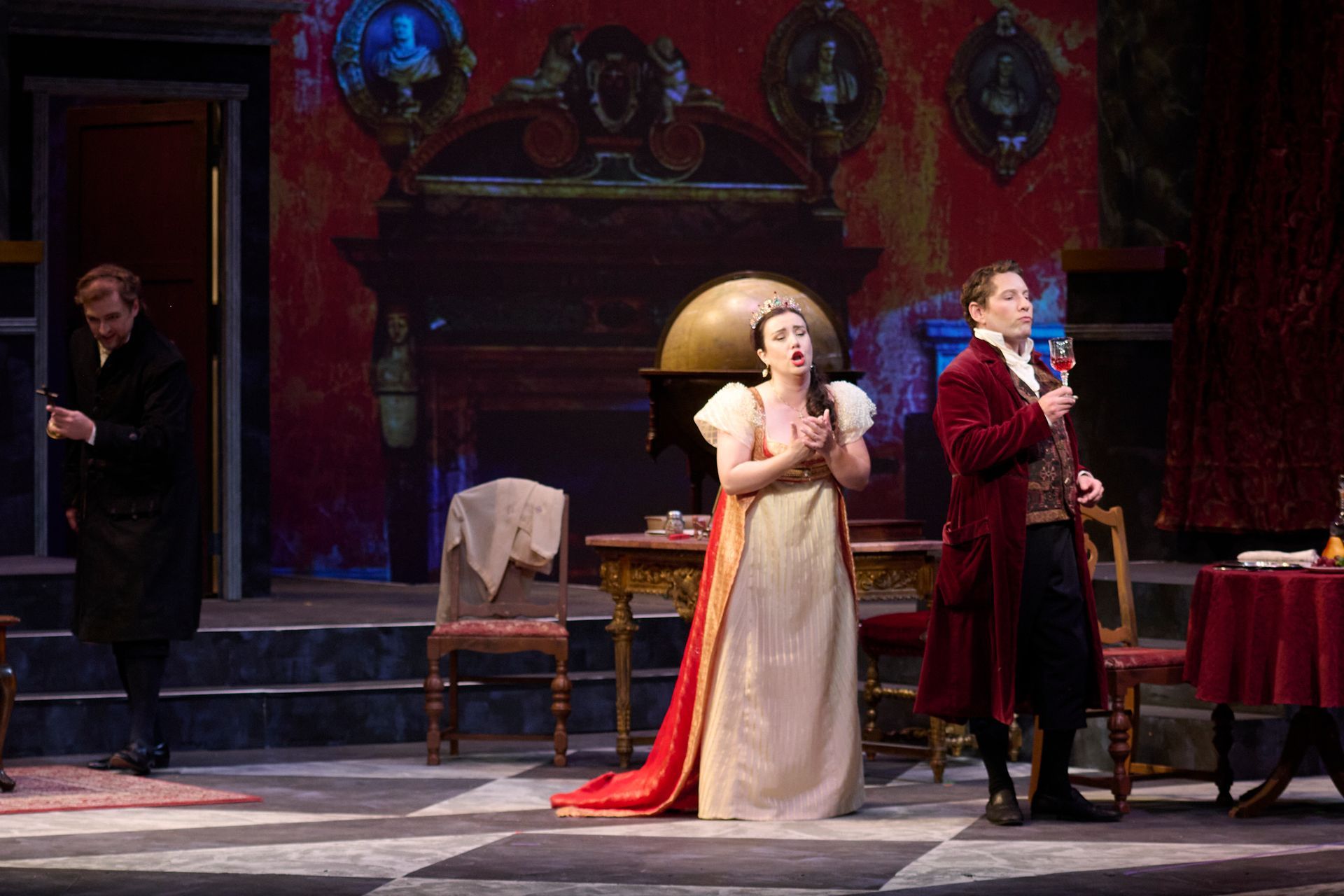
Tosca - 2026 - Media Gallery
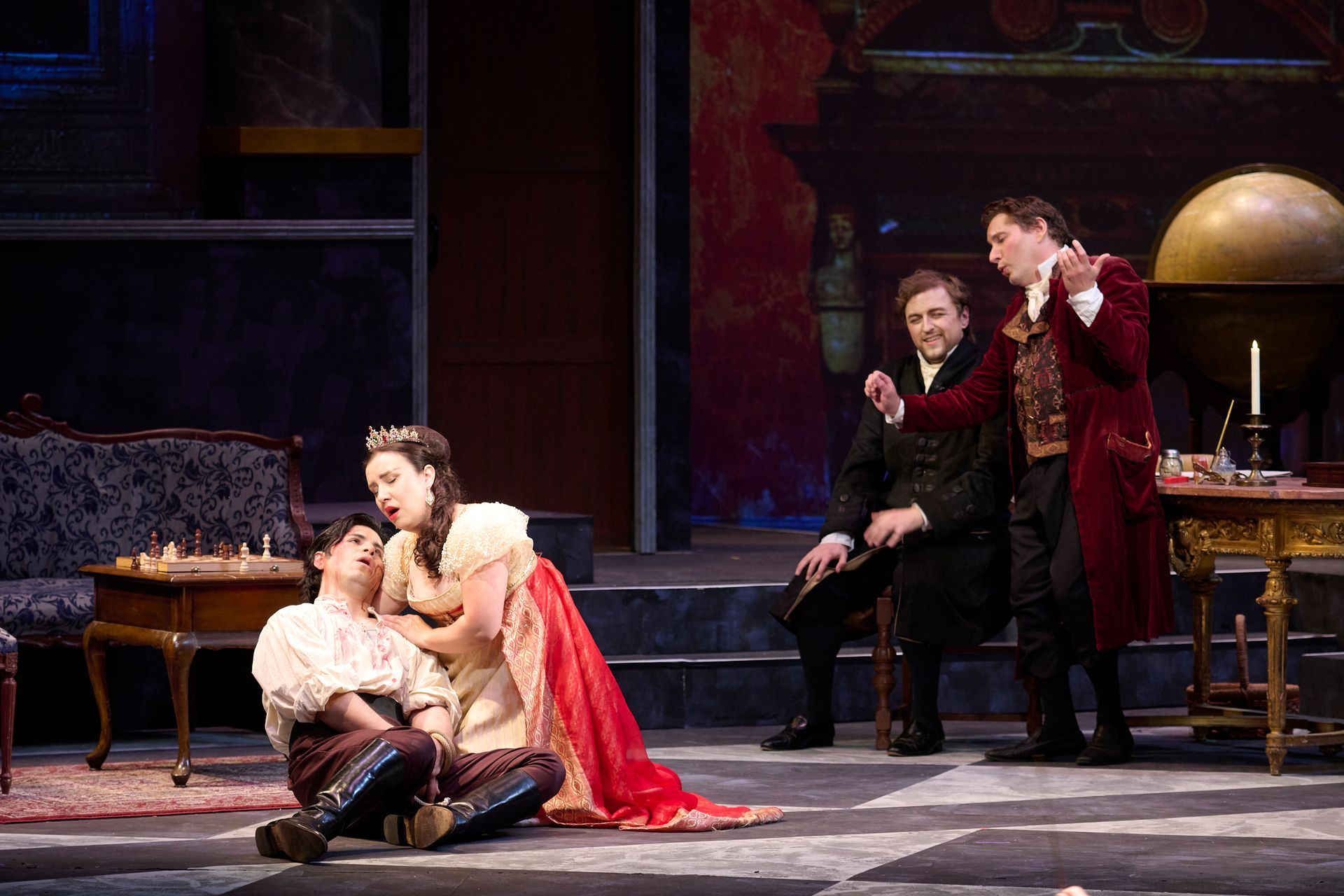
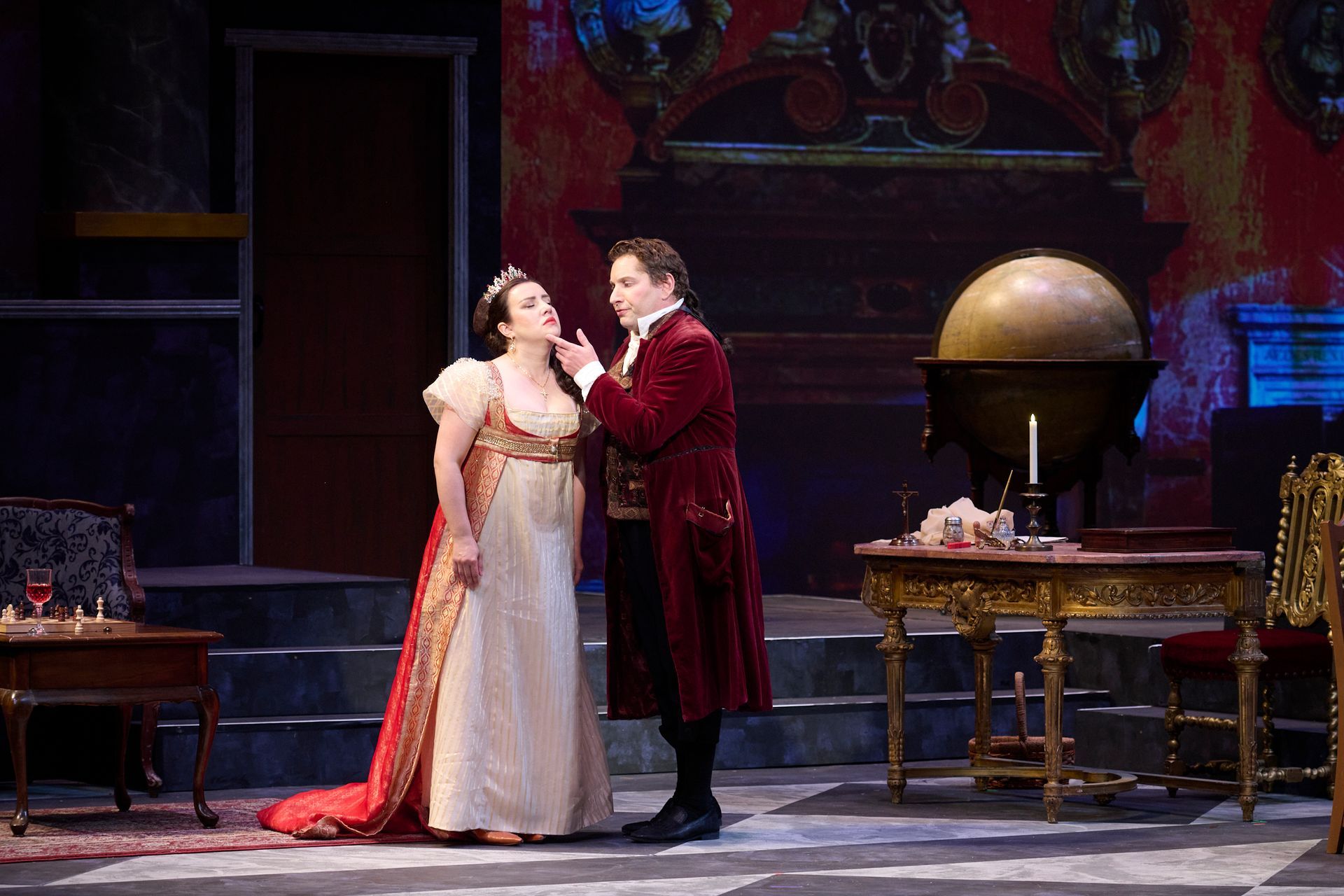
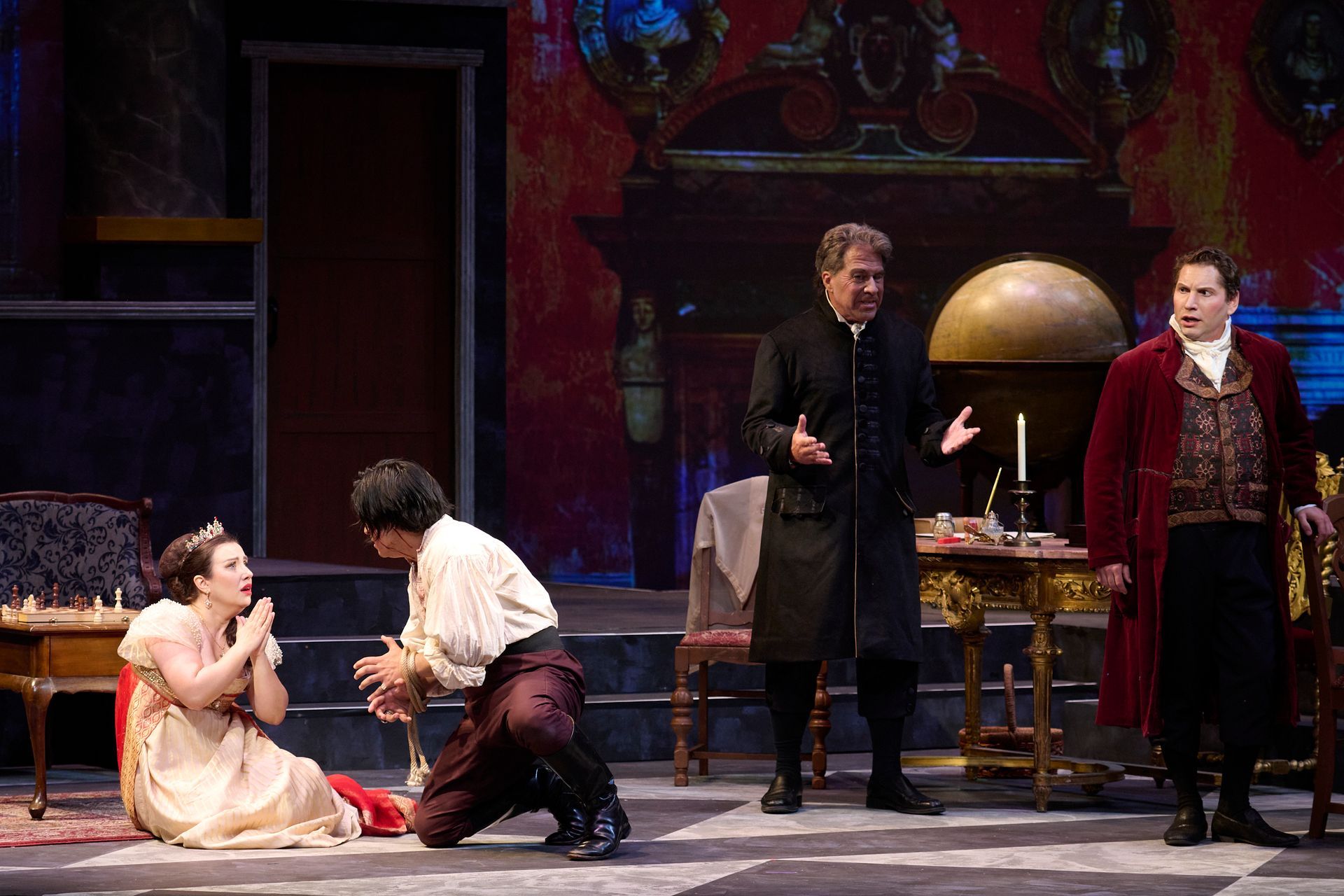
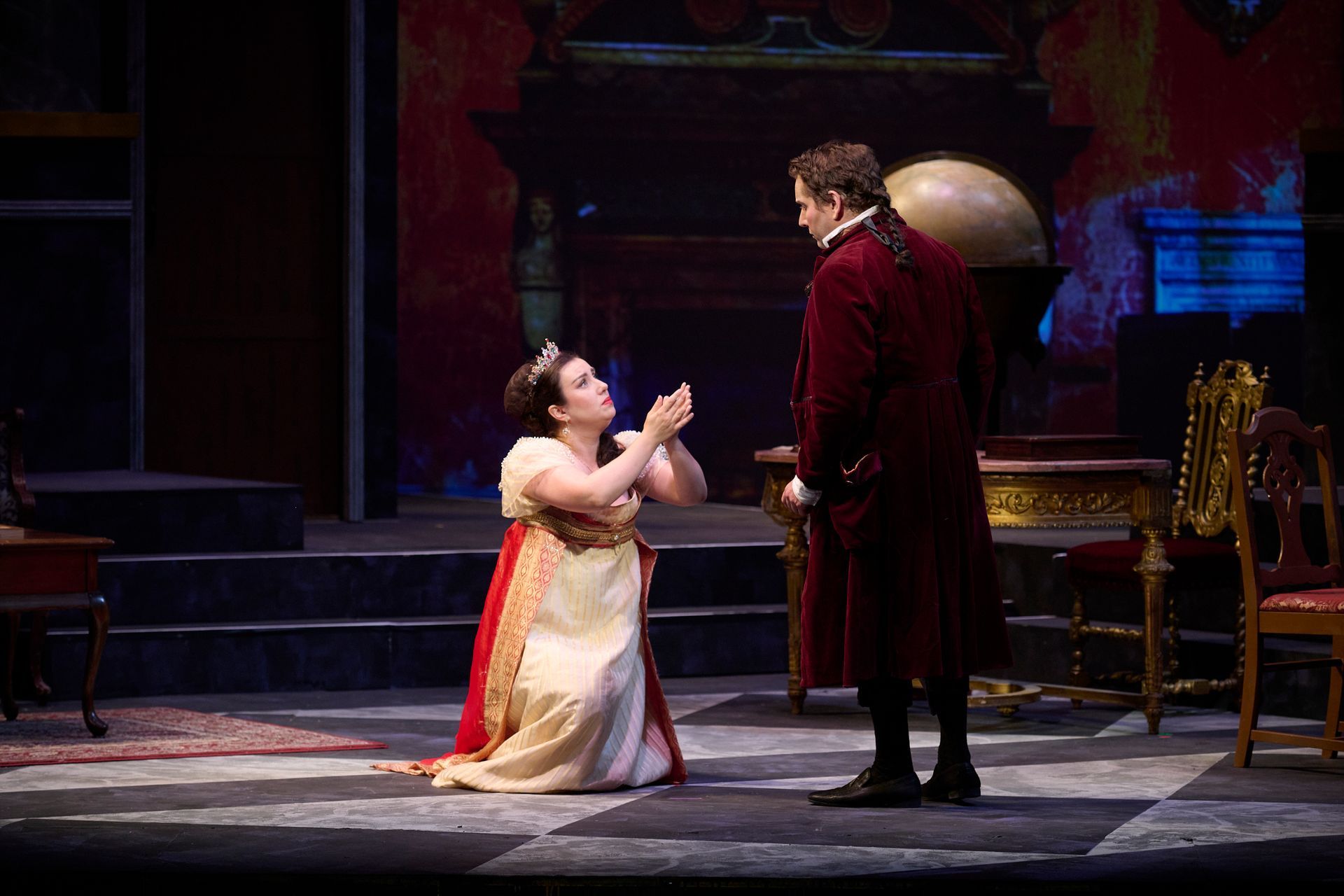
PRODUCTION PHOTOS by Natalia Polyakova
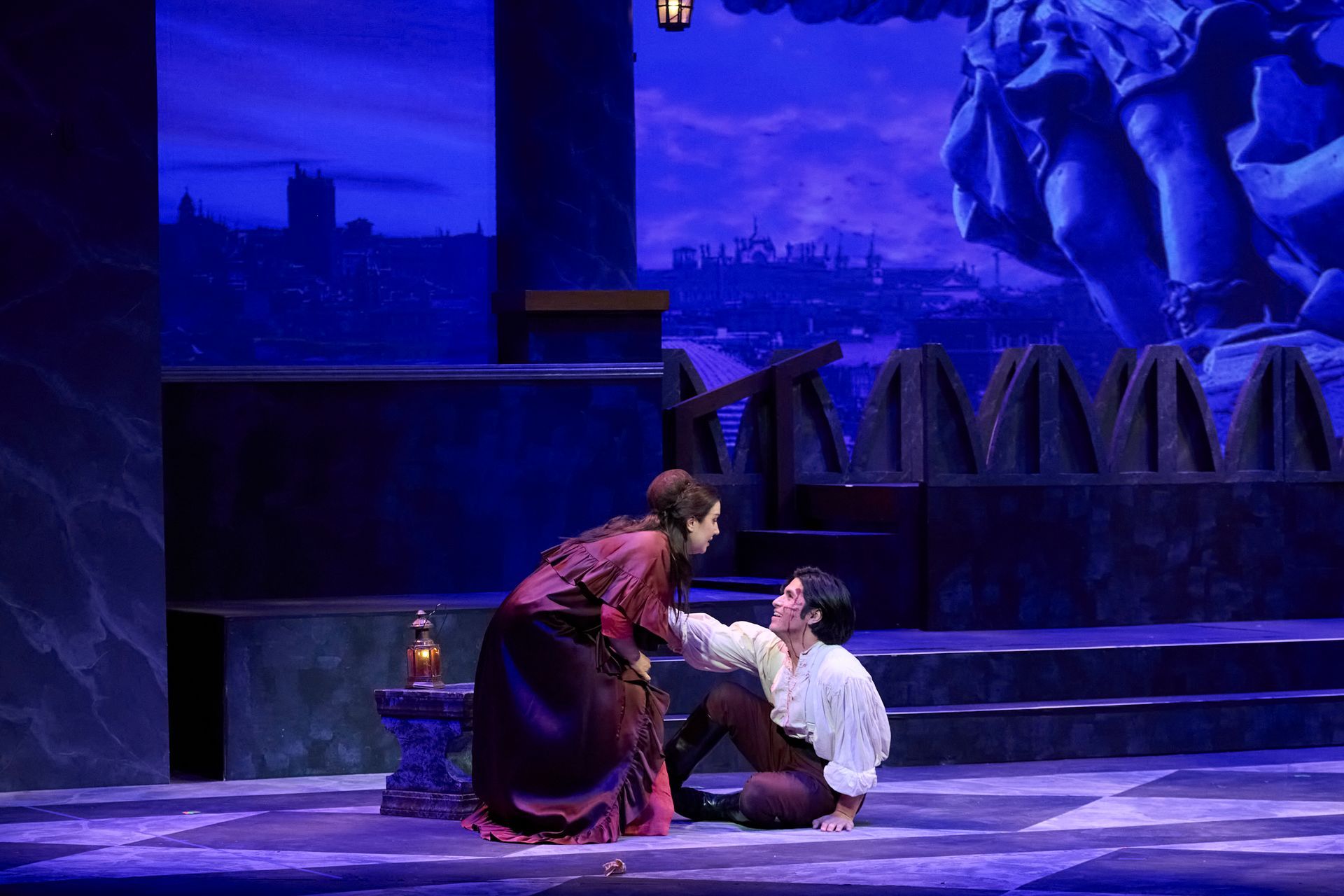
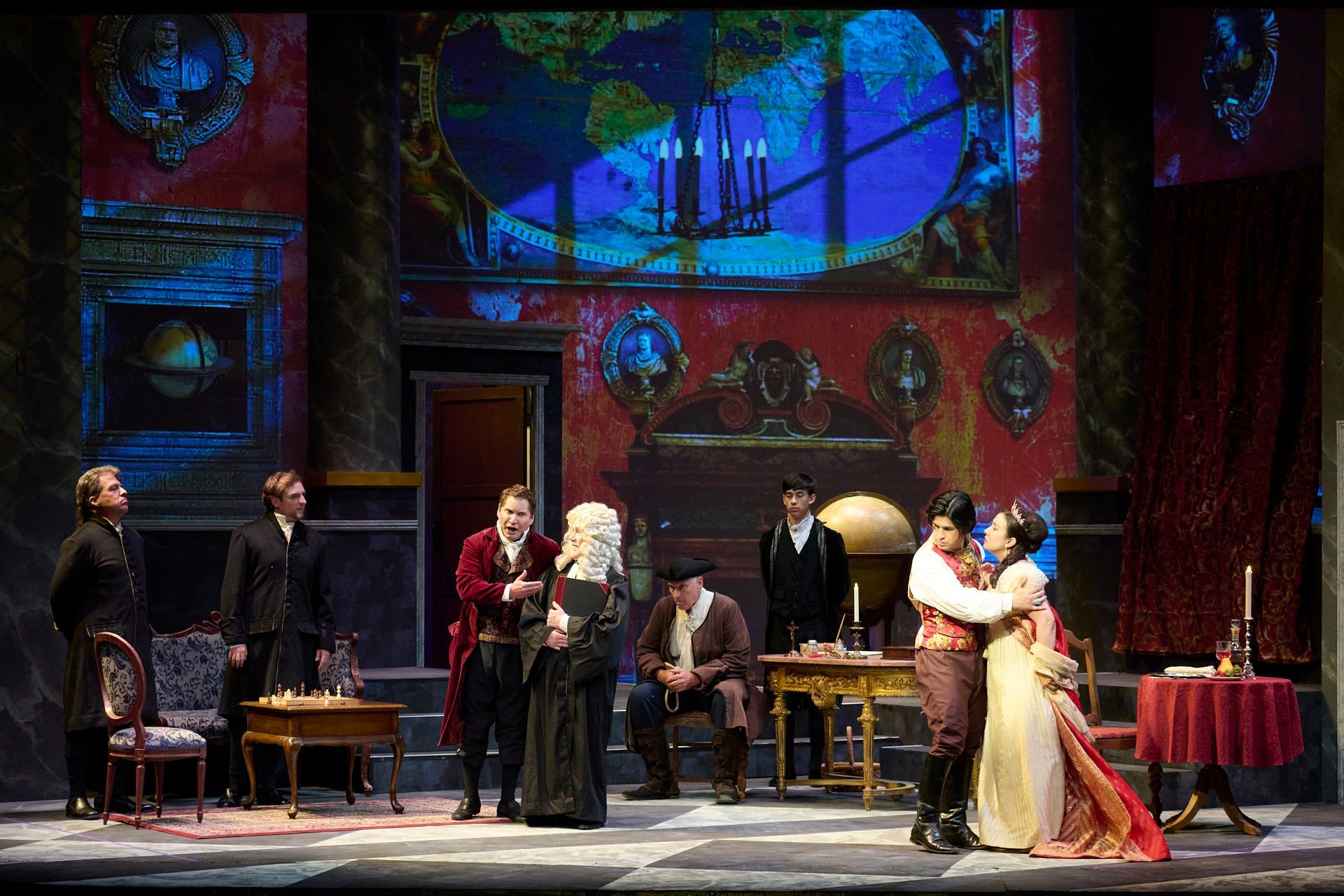
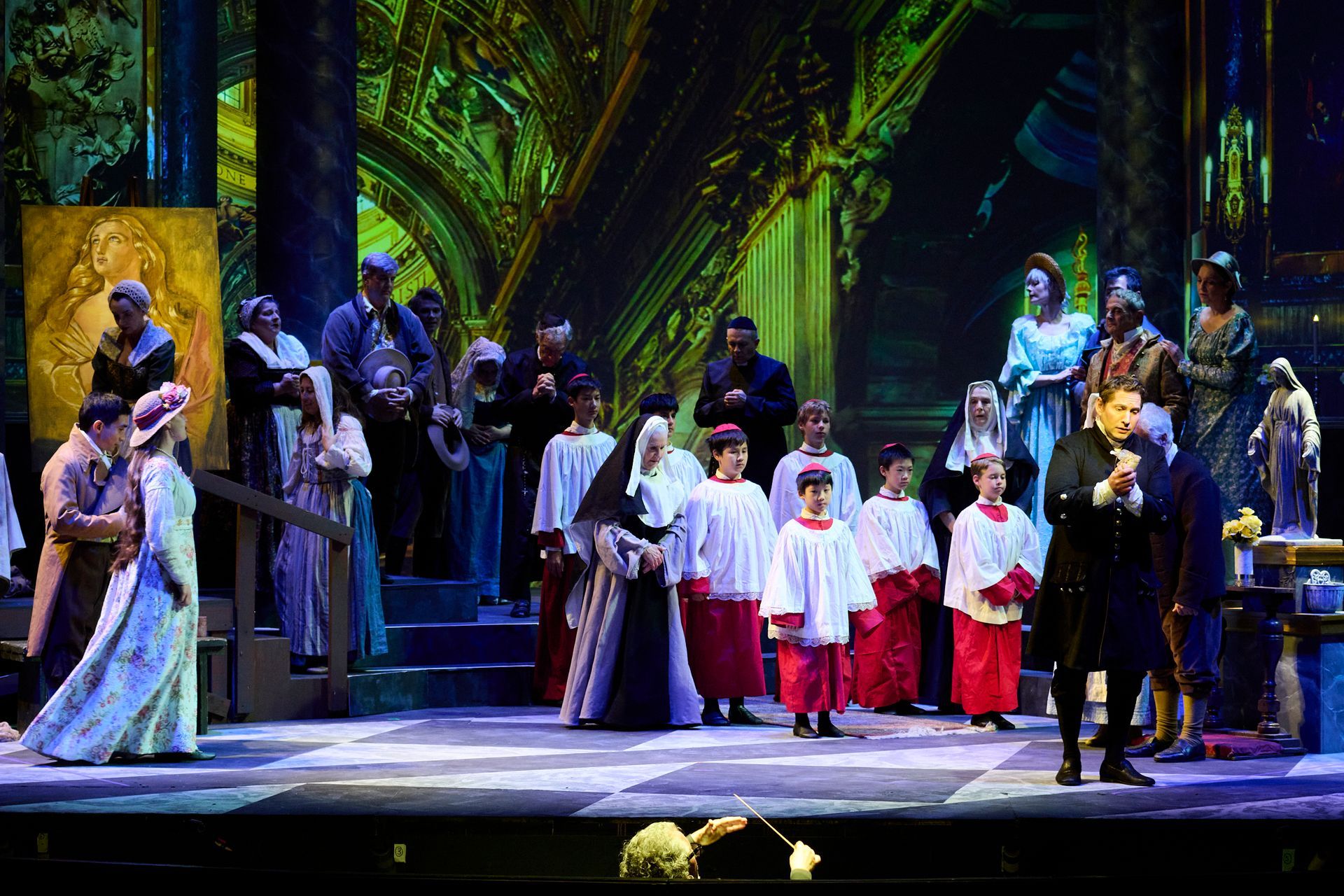
Tosca 2026 - Press and Reviews
Read the review by Eddie Reynolds in Theatereddies
Tosca
Giacomo Puccini
Libretto by Luigi Illica & Giuseppe Giacosa
West Bay Opera
With music that flows with abundant passion and fury, with performances directed and acted with creative insight and fervor, and with a setting made grand and glorious by massive and majestic projections, West Bay Opera once again proves with its current production of Giacomo Puccini’s Tosca that the second oldest opera company in the West can more than hold its own even among companies multiple times larger in scale and scope. And with three key principals that any opera company would envy to have in the starring roles of this oft-performed, much-beloved opera, West Bay is guaranteed to wow its audiences with a Tosca they will long remember.
The tightness of the timeline of Tosca – with all the action occurring in less than twenty-four hours – as well as the historical context of Napoleon’s June 17, 1800, approach toward Rome only enhance the stakes and the tension of Luigi Illica and Giuseppe Giacosa’s libretto. The storyline is brimming with torture, murder, and suicide as well as romantic flirting, jealousies, and fruition. The difference between life and death or between love gained and love lost centers time and again on decisions that must be made on incomplete information. The frailty of human existence in a time of national upheaval rings as true today as it did over two centuries ago in light of the invasions and conflicts currently disrupting thousands of lives around the globe – everyday people much like Puccini’s singer Tosca, painter Cavaradossi, or patriot prisoner Angelotti.
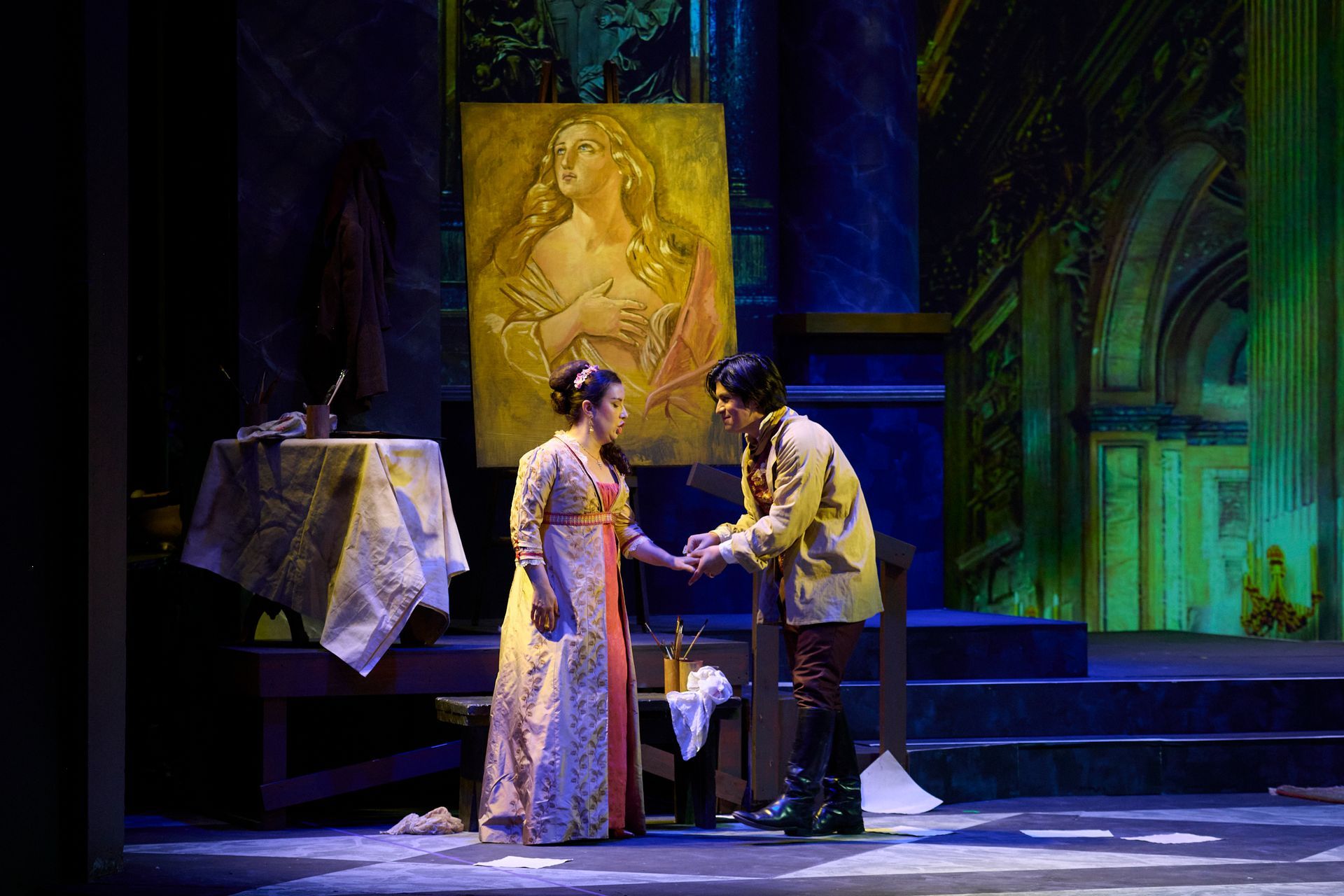
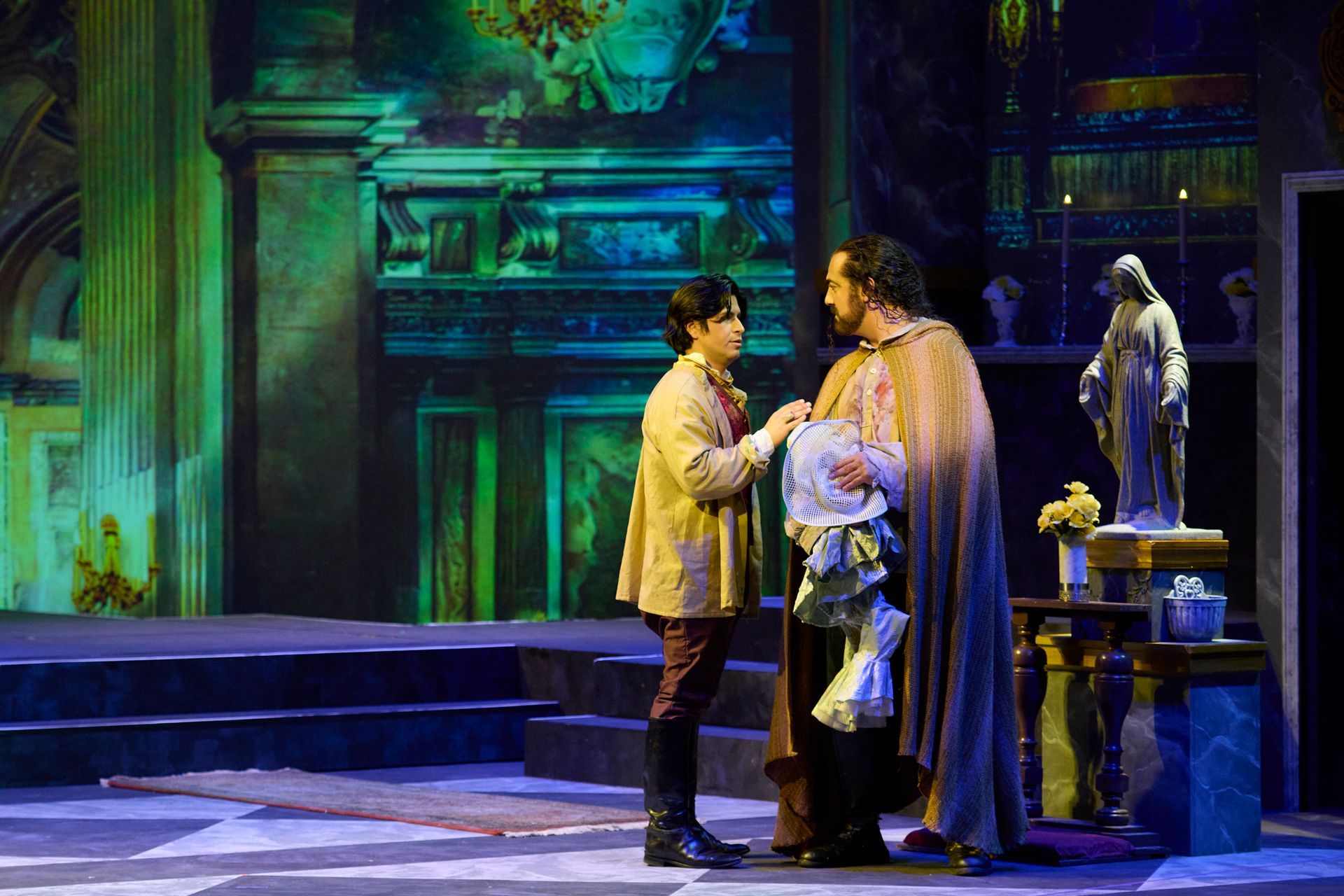
When the former counsel of Rome and now escaping political prisoner, Cesare Angelotti (bass Isaiah Musik-Ayala), arrives at a chapel to look for a disguise left by his sister, he is discovered by his friend, Mario Cavaradossi (tenor Xavier Prado), who is painting a Madonna whose face resembles Angelotti’s pious sister whom the painter has previously observed praying. Cavaradossi hides his friend from the pursuing police, sealing his own fate without knowing it as he sings with deep-felt, resounding conviction, “Even if it would cost my life, I will save you
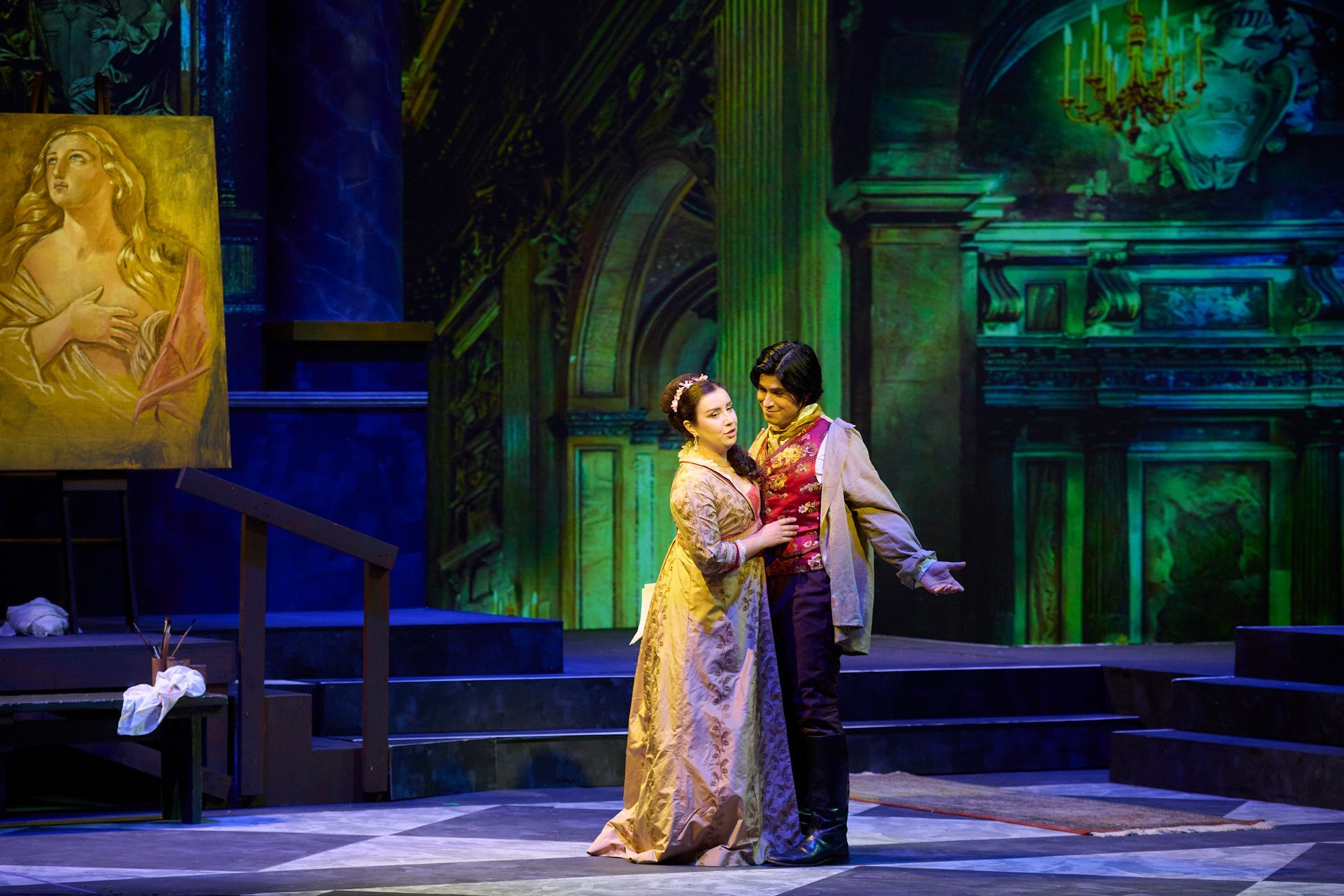
Soon to enter is the enticingly attired Tosca to catch a moment and maybe a kiss from her beloved artist. Upon hearing another voice as she arrives, she suspects Mario of unfaithfulness, especially when seeing his Madonna of blue eyes rather of those much darker like her own.
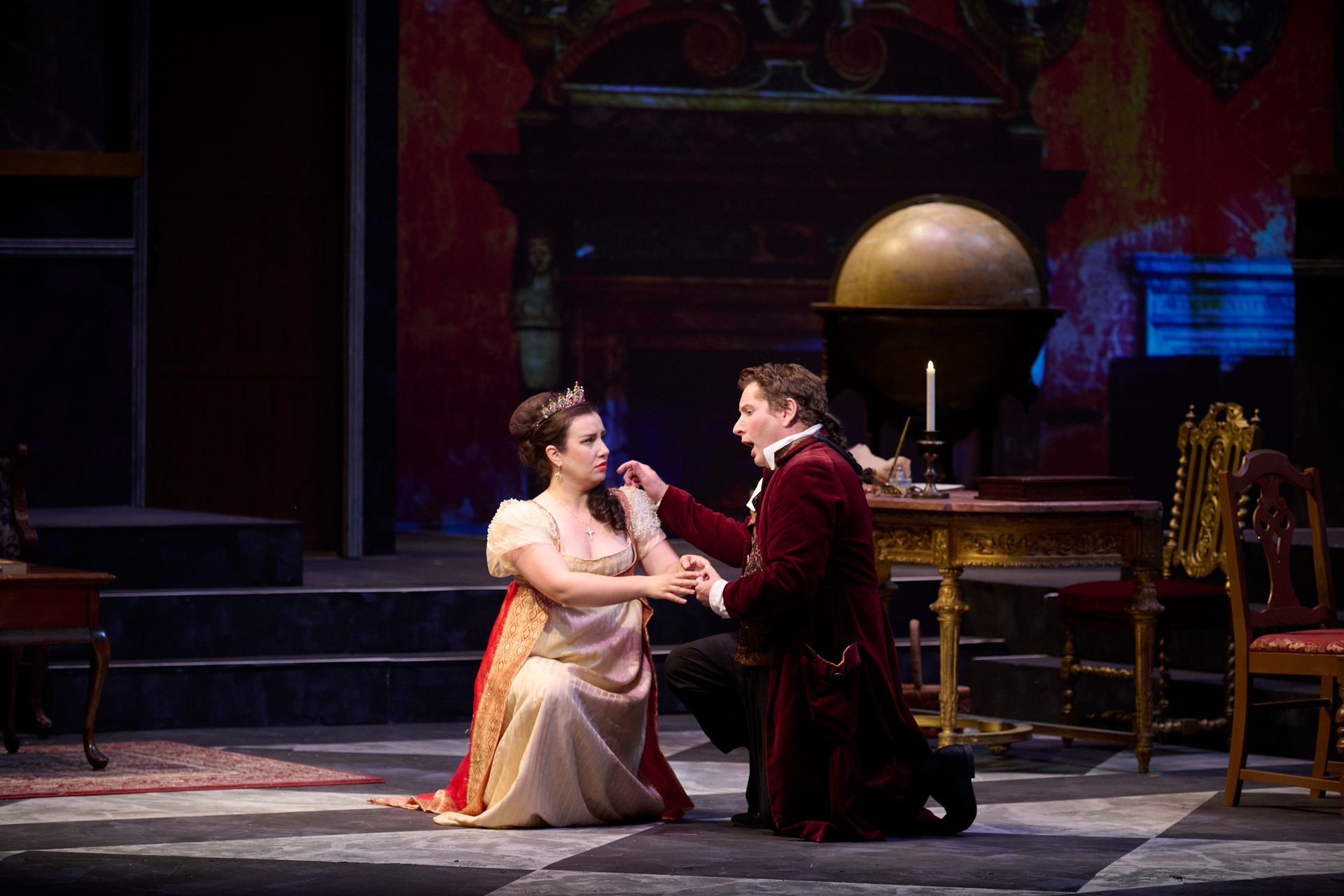
What follows is our first real chance to revel side by side the voices of Julia Behbudov and Xavier Prado, soprano and tenor extraordinaire respectively. Her bout of accusations and his pleas of innocence are followed by their declarations of true love, with each voice beautifully projecting its pristine clarity and emotional depth.
Tosca asks Mario (in English translation of the original Italian libretto), “Do you not long for a little house that awaits us,” her notes painting in flowing, effusive patterns even more vividly than her words how “Tosca burns with a mad love” for her Mario. His tenor responses of resplendent notes build to a passion-filled peak that near shake the rafters of the Lucie Stern Theatre and certainly cause our own hearts to flutter.
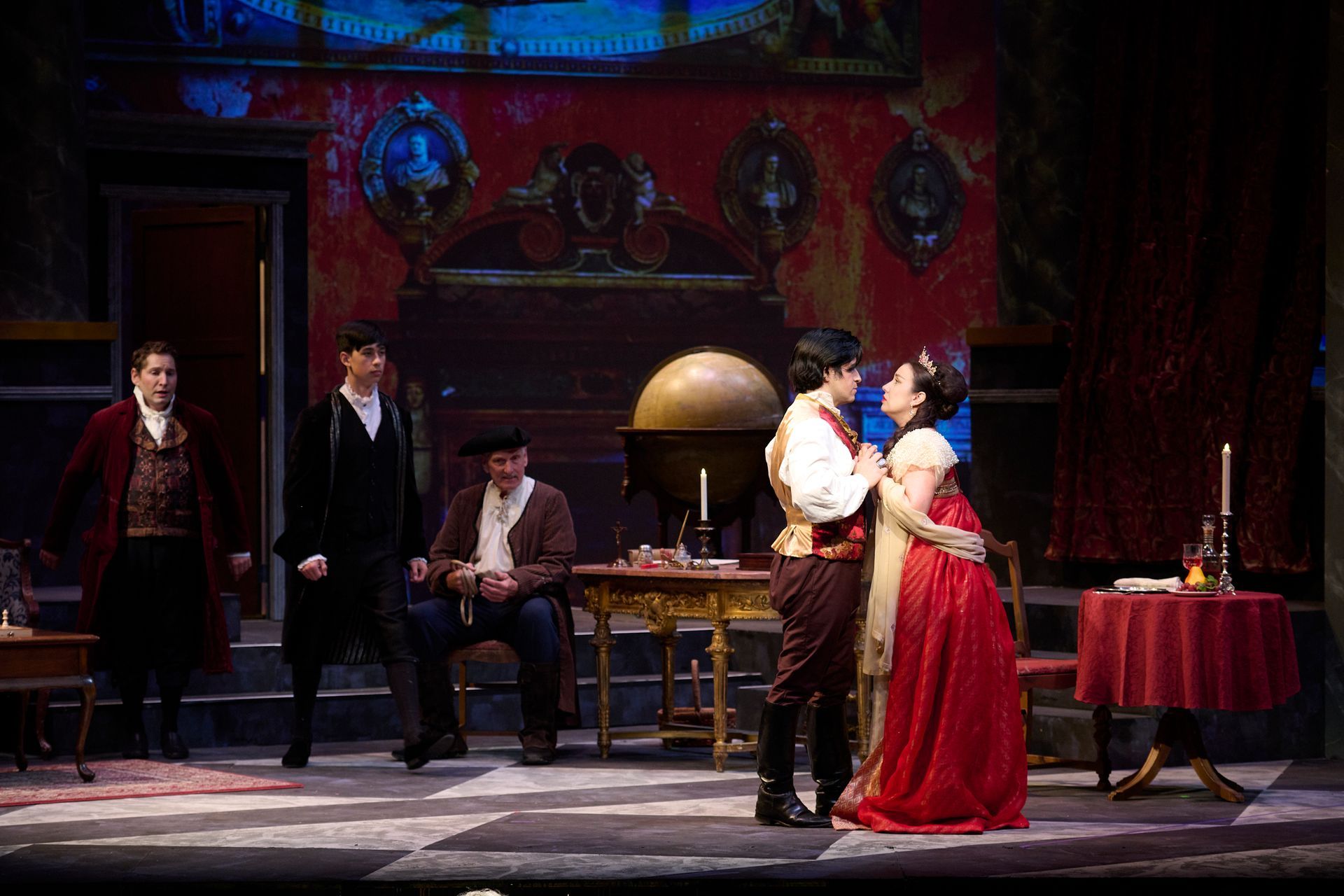
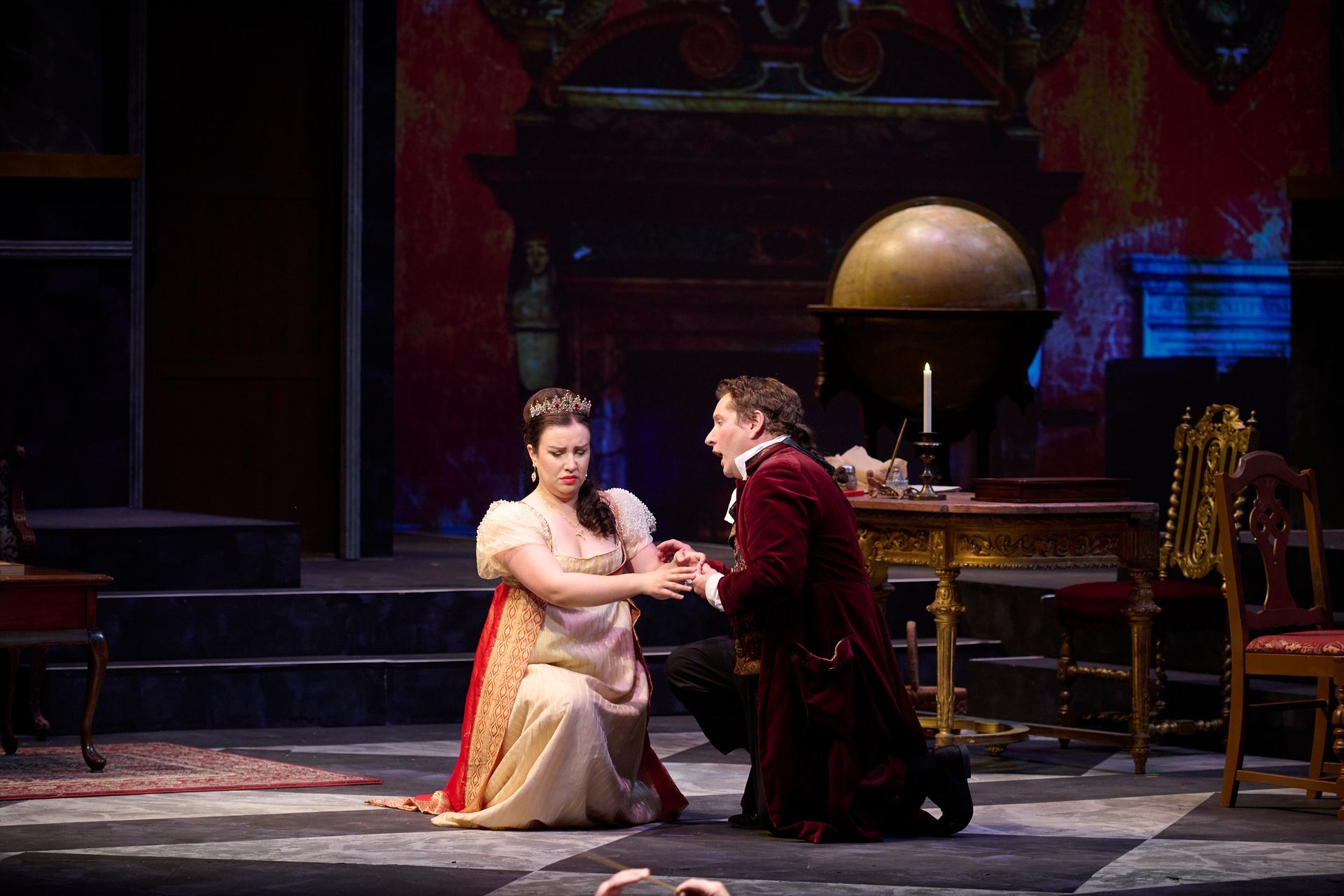
In a departing duet, their voices tightly intermingle in heart-pounding blends even as their bodies mold into one. From this, our first introduction of the two together until their final, fateful embrace only a few hours later, there is a palpable, pulsating passion in the love felt and expressed between this pair of lovers.
As Tosca, Julia Behbudov exudes time and again richly rounded notes that express the wide range of life-affirming, death-pending emotions that Tosca undergoes in these few, fateful hours. While she at times climbs gingerly in soft notes to heavenly highs in describing her love for Mario, she equally if not exceeds in countering with astounding power and presence other moments of anger, defiance, or fear in notes of sheer, soprano catharsis. Particularly memorable is when her Tosca questions God how her past reverence and devotion have been answered by the torture she currently faces of making a choice between her lover’s life and her own chastity. Heart-touching notes pierce the air with her reverberating pleas to understand, “How do you repay me thus?”
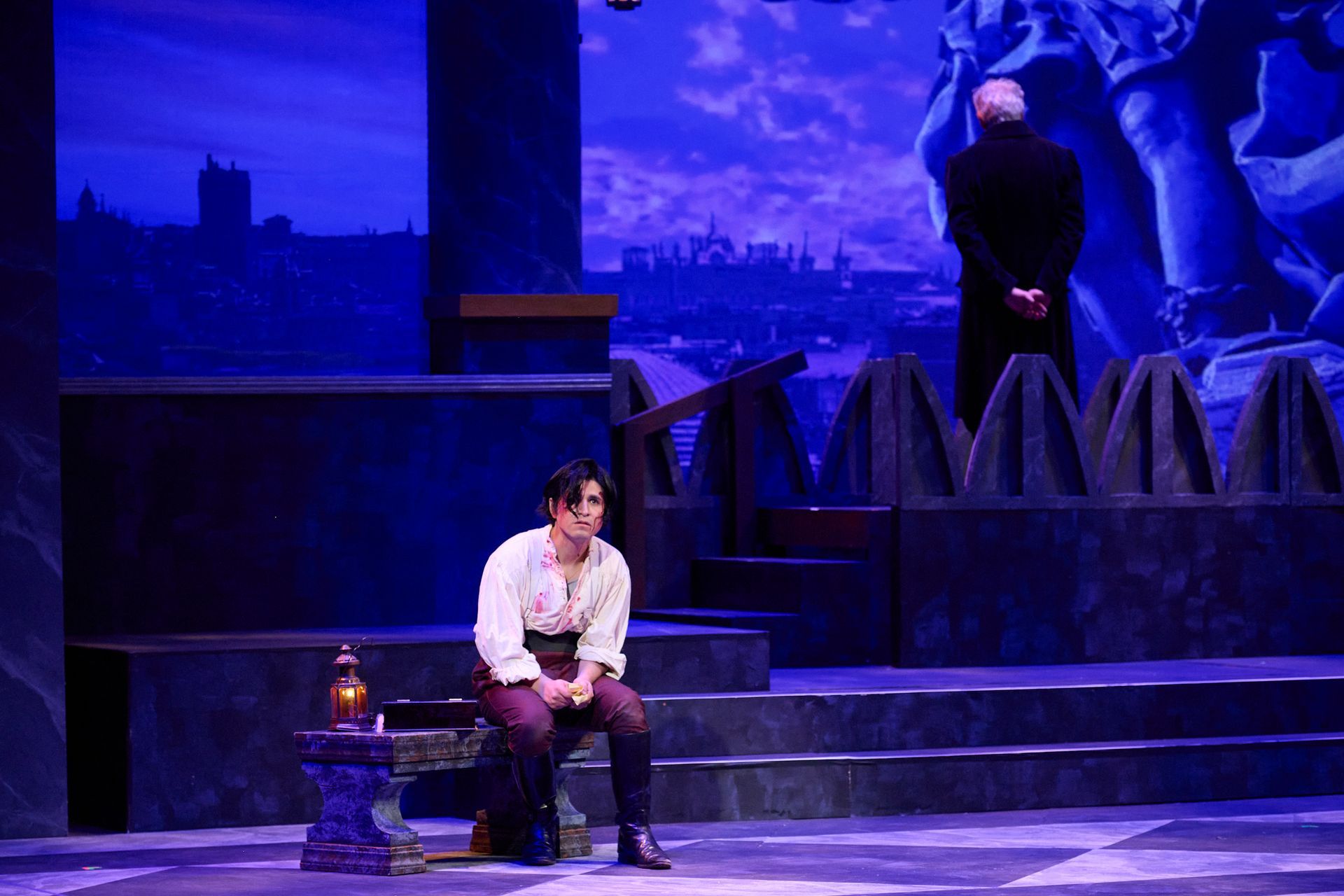
Similarly, Xavier Prado’s Mario provides bountiful reasons to extol his noteworthy performance. In a final aria as he awaits execution, he remembers the scent of perfume and the feel of kisses of his Tosca, singing notes that throb as they beautifully project his fervorous affection. As he tenderly sings of “sweet kisses” with tenor heights that grab our hearts and elicit our tears, his Mario once again shakes our very beings with a cry of anguish before collapsing in despair of his fate.
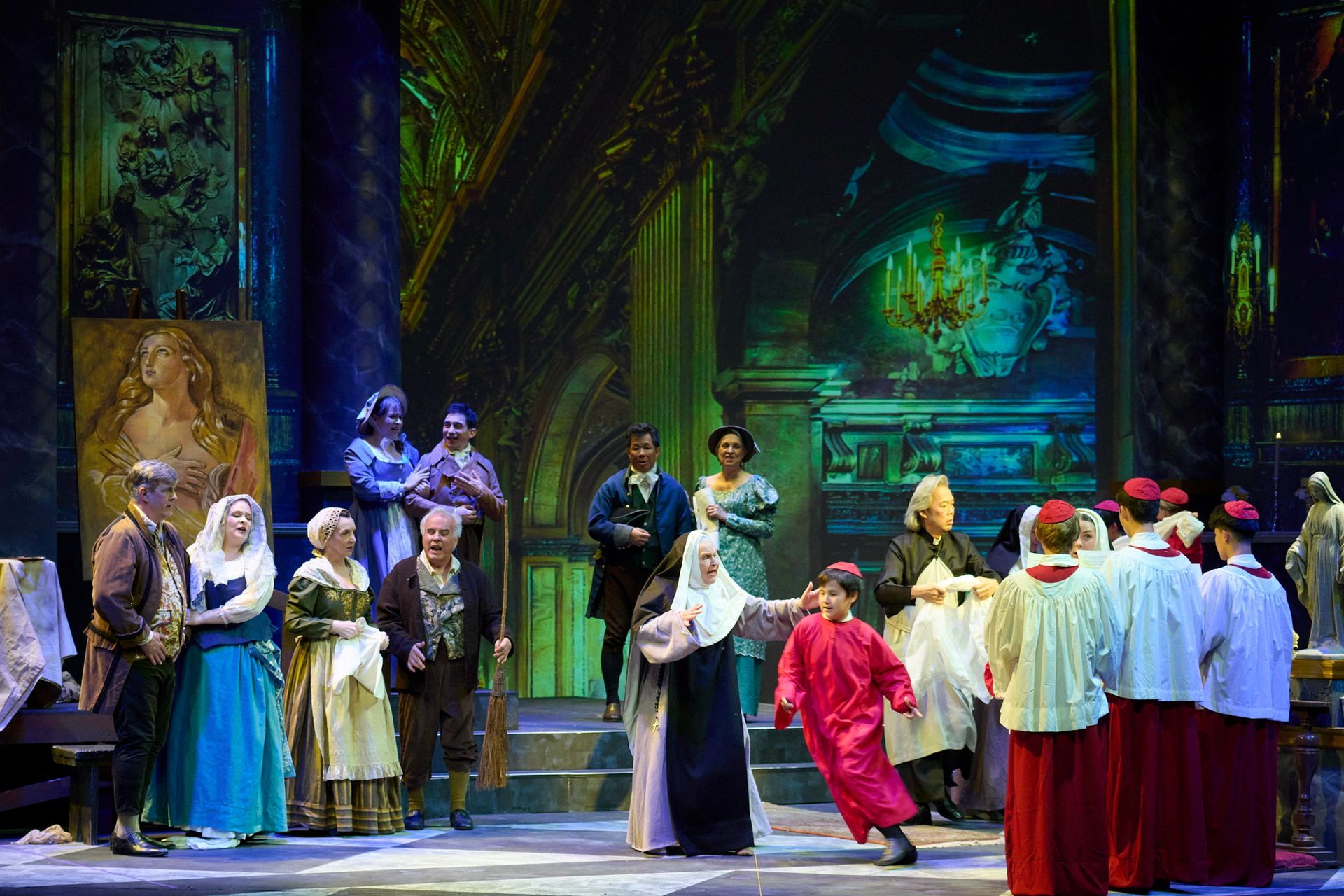
Not to be overlooked as equally notable is the sinisterly stellar performance of Robert Balonek as Baron Scarpia, whose evil, slithering manner and his booming baritone voice repeatedly come close to being the performance’s showstopper. When Rome’s Chief of Police first enters the chapel just as services and “Te Deum” are about to begin, his vibrating chords trumpet his arrival as he scolds the assembled whom the pompously pious Scarpia believes are being too jovial and chatty.
Those first, reverberating notes are a preview of a voice that later seethes in a rich, but disturbing sung plot of how he plans to force Tosca into his bed as a means supposedly to save the life of Cavaradossi, whom Scarpia knows has helped the traitor Angelotti to escape. When he sings of his own near-frantic desire for Tosca, he softens in tones for a few brief moments to sing with an impassioned flair that is almost believable as genuine love, but the building lust soon takes commands in his notes, especially as he gloats of the upcoming gallows for his rival in love, Mario. His Scarpia leans into his sung phrases with such power and persistence of tone to send shudders down one’s spine, particularly as he describes what will happen to Tosca’s lover if she does not acquiesce to his demands
The high drama of the story works so well because Puccini keeps these three and their fates always in our primary focus. Other fine singers like the exacting excellence of the richly voiced Chung-Wai Soong as the priest Sagrestano deserve much praise, including a beautifully blended Chorus of twenty (under direction by Bruce Olstad) and a charming group of Altar Boys from the Silicon Valley Boys. Choir.
And as is always true for a West Bay Opera production, tremendous kudos goes also to Conductor José Luis Moscovich for another score’s rapturous rendering. I sometimes found myself turning my focus from the stage just to relish the orchestra’s intricate and enticing rendition of Puccini’s score.
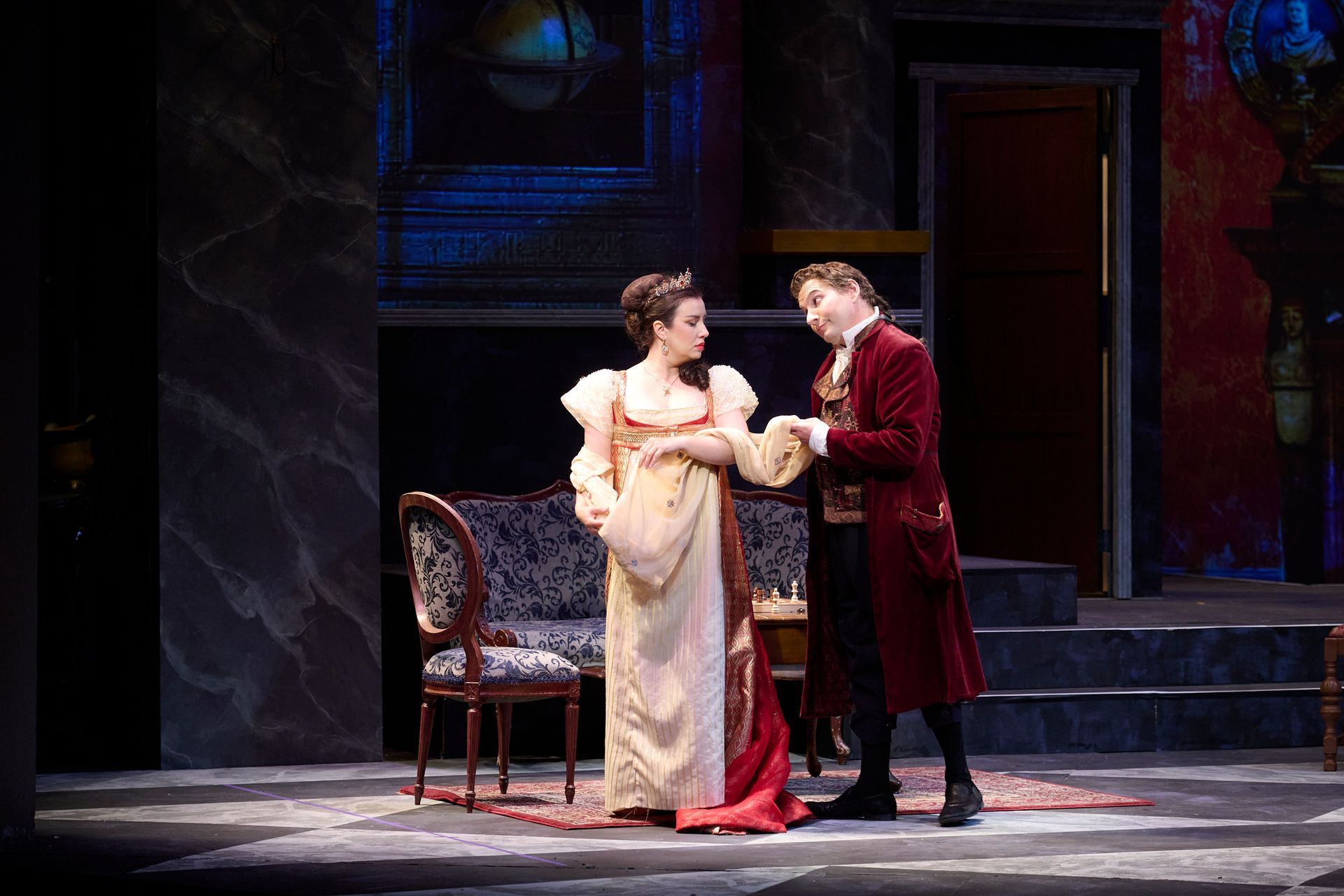
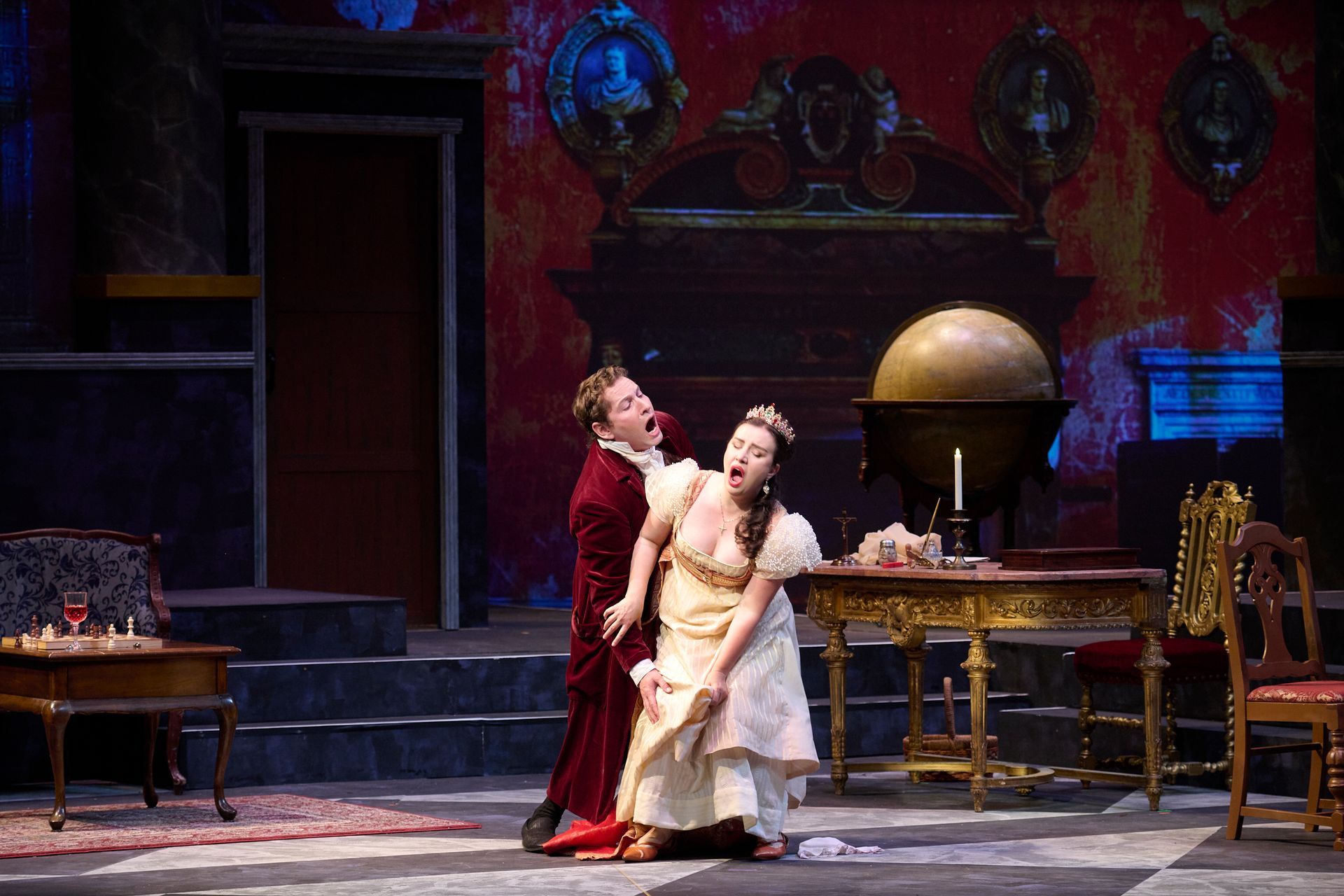
Throughout the performance, many subtle but wonderfully impactful decisions have been made by Stage Director José María Condemi that pay off big time. The first time Scarpia encounters Tosca in the church as she is weeping in her belief of Mario’s love of another, Scarpia offers her his handkerchief to wipe her tears — a handkerchief that becomes a repeated victim of his clasped hands as he sniffs her lingering fragrance, something he will also later do again with a scarf taken from her neck. When he is trying to seduce her in his apartment, the licentious devil slides his hands down her gown as she recoils, with her immediately desperately trying to wipe his prints and presence off the skirt’s folds. She had also just wiped with vigorous efforts her own hands after he had clasped them in his forceful supplication of her love. These are just a few examples of a director’s touch that heighten greatly the power of an already magnificent libretto.
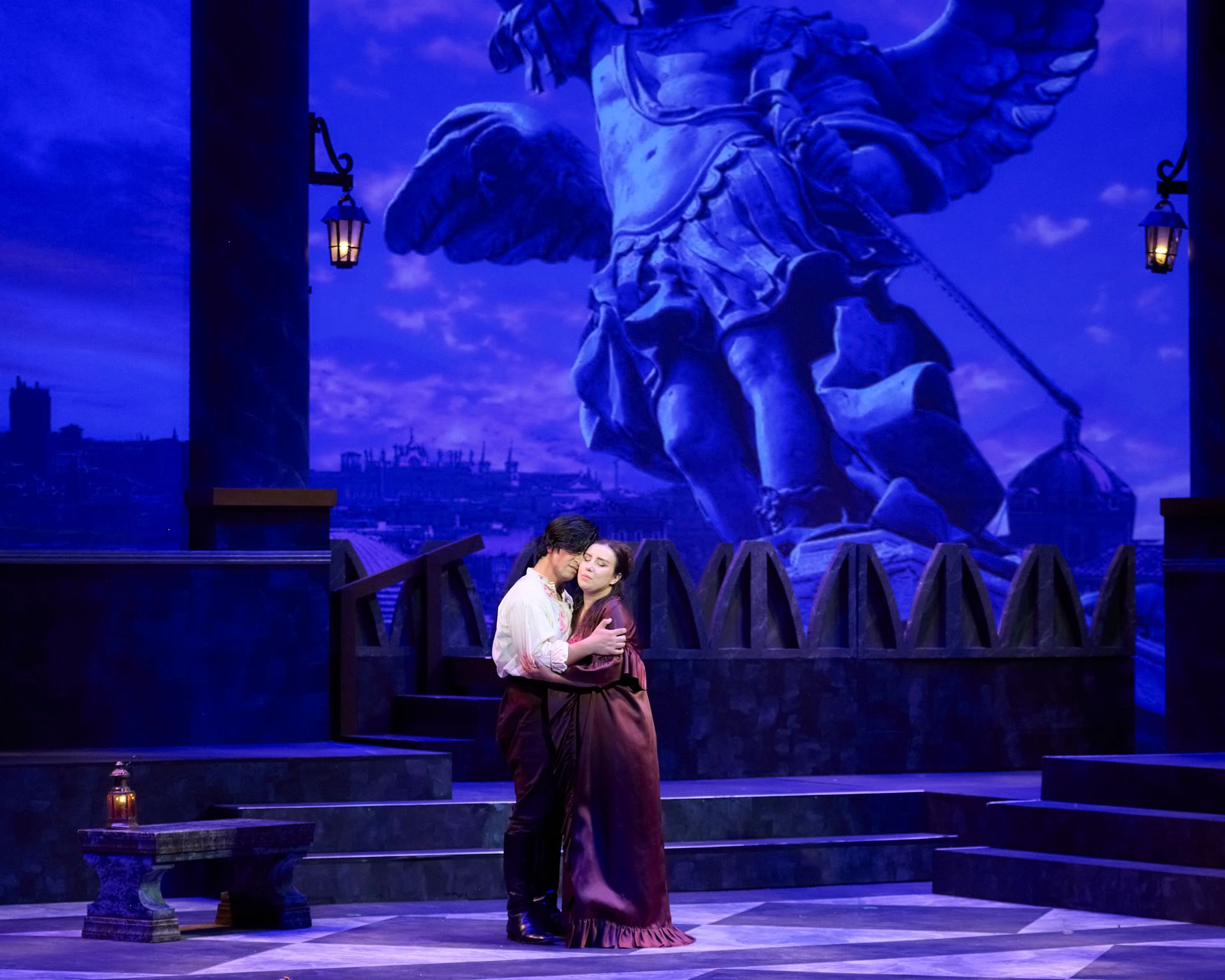
The larger-than-life settings of the three acts — a high-ceilinged, lavishly adorned church, an apartment smacking of wealth and power, and a prison’s rooftop terrace with foreboding statuary and a city’s darkened skyline in the background — have been designed in set and projections with rich colors and in colossal proportions by Peter Crompton and have been populated with period-perfect properties by Shirley Benson. The lighting designs of Daniele Ferguson add the finishing touches to create scenes and settings that house impressively and expressively the passionate intrigue and events of the opera. Callie Floor’s costumes splendidly depict the various professions, classes, and personalities of the cast and chorus aided generously by the wigs and make-up design skills of David Gillam.
Whether a Puccini aficionado or novice, West Bay Opera’s Tosca is a local offering of his masterpiece not to be missed by Bay Area audiences. With only two more performances, grab a ticket quickly so not to be left disappointed by probable sold-out audiences.
Rating: 5 E
A Theatre Eddys Best Bet Performance
Tosca continues May 30 and 31, 2026, in a three-hour production (two intermissions) in production by West Bay Opera at Lucie Stern Center, 1305 Middlefield Road, Palo Alto. Tickets are available online at https://www.wbopera.org/ or in person/by phone at the box office Monday – Friday 1-5 p.m. at 221 Lambert Avenue, Palo Alto (650-424-9999).
https://theatreeddys.com/2026/05/tosca-3.html
Read the review by Michael Vaughn in the Palo Alto Online
Review: Politics, lust and religion bring topical high drama in ‘Tosca’
West Bay Opera stages Puccini’s classic with excellent voices in primary roles
by Michael J. Vaughn
West Bay Opera stages Puccini’s “Tosca.”
With its themes of sex, politics and religion, the opera feels as topical as ever in today’s climate.
If it’s true that classic works are ever-topical, it’s also true that these works might have times when they seem hugely relevant. Thus, “Tosca,” Puccini’s notorious potboiler, which lands at the meeting point of sex, politics and religion, is having a real moment. West Bay Opera makes that point with a robust production featuring three excellent primary voices.
We open with baritone Chung-Wai Soong, playing the Sacristan with an amusing crabbiness, eager to rat out the painter Cavaradossi, who’s painting a Maria Magdalena with the face of a local beauty. As it turns out, the lady was there to plant some necessaries for her brother Angelotti (bass Isaiah Musik-Ayala), a political prisoner who has just escaped the nearby Castel Sant’Angelo. Discovering his fugitive friend hiding in the chapel, Cavaradossi vows to aid his escape, and there his troubles begin.
Tenor Xavier Prado performs Cavaradossi as a force of nature, producing blazing ribbons of sound (reminiscent of 1950s divo Mario Del Monaco). His lover is the resident diva, Floria Tosca, played by soprano Julia Behbudov with equal power but also a sense of dynamic play that goes well with Prado’s bluster.
Tosca visits the church worksite and proceeds to distract her boyfriend incessantly, indulging in playful jealousy over the familiar face in the painting. The two singers bring out the remarkable charm and efficiency of this scene, the way that Puccini and his beleaguered librettists Illica and Giacosa manage to outline a complex relationship in such a brief time.
The riches continue with the introduction of baritone Robert Balonek as Scarpia, the hugely corrupt, narcissistic chief of police. Scarpia has two goals in mind: squashing any resistance to the church’s authority and somehow getting his hands on the luscious Tosca. When he discovers that Tosca’s lover might be involved in Angelotti’s escape, you can almost see him drool. His enormous hypocrisies are spelled out in the grand Te Deum, in which the chorus sings a hymn of thanks as Scarpia dwells on his lustful desires (“Tosca, you make me forget God!”). It’s one of Puccini’s more masterful innovations, delivered in resounding fashion by the West Bay chorus (Bruce Olstad, chorusmaster) and Balonek’s rich, agile singing.
In the second act, Scarpia delivers a manifesto that could have been written yesterday: “The flavor is stronger in violent conquests. The thing I crave, I pursue. When I’m satiated, I throw it away.”
After arresting and torturing Cavaradossi, Scarpia and Tosca come to a creepy “understanding” — sex for liberty. Jose Maria Condemi’s kinetic staging suddenly closes to a single spotlight for the heartbreaking aria “Vissi d’arte.” The approach succeeds in internalizing everything. Behbudov stands alone in the darkness and assembles the meaning of Tosca’s life with lovingly crafted lines that fray into gasping inhalations and desperate pleas to God. Her performance was captivating, and the West Bay audience responded with a lengthy European-style ovation.
As the lights come back up, (spoiler alert!) Tosca discovers a renegade steak knife and greets Scarpia’s embrace with an excellent stabbing, a hearty thrust to the midsection. The sudden shifting from contemplative to violent makes an already thrilling production absolutely electric.
Jose Luis Moscovich and his orchestra match the power of their singers, with the confidence of playing on familiar ground. The company’s practice of filling the wings with instruments also offers some intriguing side-effects. A particular three-note torture theme struck my ears with unexpected vigor, and I realized I was directly lined up with Jason Hebert’s bass trombone.
Frederic O. Boulay’s projections played across multiple screens for the interiors, but made their biggest impression with the enormous figure of Sant’Angelo’s iconic sculpture of Michael the Archangel. Special kudos to Patrick Fallows, the youngster who sang the shepherd’s song from the wings. For you true Toscaficionados, the final leap from the parapet was a straightforward drop, as befitting a diva. I also enjoyed Michael Pleban, the tall super who played Scarpia’s torture specialist. It’s good to see a man who enjoys his work.
West Bay Opera stages “Tosca” through May 31 at the Lucie Stern Theatre, 1305 Middlefield Road, Palo Alto. $54-$140. In Italian with English supertitles. 650-424-9999 or wbopera.org,
Read the review by Victor Cordell in BerkshireFineArts.com
Giacomo Puccini is renowned for soaring lyricism and accessibility in his operas. What many aficionados do not realize is that with the exception of his failed first full-length opera, Edgar, the title character of each of his seven three-act operas is female – a testament to his love for the female voice. While most of his heroines – Mimi, Cio-Cio San, Manon, and Magda – are designed for lighter voices, Tosca is the most demanding of his female roles and one of the challenges in all of opera. It is long and mostly dramatic, with shrieking and demanding range, yet requiring lyric beauty.
Although some find Tosca dark and overwrought, its libretto by Luigi Illica and Giuseppe Giacosa offers the proper complement of characters with a protagonist, a love interest, and a venal antagonist. One might question whether Tosca is the protagonist and Cavaradossi the love interest or vice versa, but undoubtedly, Scarpia is among the most craven villains in opera.
The highly dramatic plotline also embraces complexity with conflict, betrayal, retribution, misdirection, and the deaths of all major principals by different means. The music meets the demands of the libretto at every turn, including some of Puccini’s most memorable arias as well as the powerful and ominous Scarpia leitmotif.
For those not familiar, singer Floria Tosca is in love with painter Mario Cavaradossi who, having hidden an escaped political prisoner, crosses swords with Chief of Police Scarpia. The lascivious Scarpia promises that if Tosca submits to him sexually, he will save Cavaradossi from execution. Any opera lover knows that a bloodbath driven by bad faith, relentless pursuit, and broken promises ensues.
West Bay Opera offers a traditional staging of Tosca to fine effect with a trio of strong-voiced principals to lead the way. Julia Behbudov returns to West Bay having starred as Desdemona in Otello last year. Although adept in spinto roles, her dramatic vocal skills are very much in evidence in this eponymous part. Indeed, Tosca’s signature aria “Vissi d’arte,” provides a broad swath for interpretation as she pleas with Scarpia that she “lives for art” and doesn’t indulge in political intrigue. While it can be caressed and the dynamics varied considerably, Behbudov goes from forte to fortissimo in a high energy delivery. What is remarkable is that she has the voice to sing the aria after the demandingly harsh prelude of her confrontations with Scarpia earlier in Act 2.
Xavier Prado is Cavaradossi, and corresponding to Behbudov, he possesses a high range that is generally lyrical but with the additional asset of capacity for big sound. Happily, the voices of the two lovers are very compatible in their high-volume duets. Cavaradossi is twice blessed in the firmament of most loved arias. In the beautiful Act 1 “Recondita armonia,” (“Hidden harmony”), he caresses the sounds of reconciling his appreciation of the beauty of another woman yet thinking only of Tosca.
His highlights are bookended with his passionate and ominous “E lucevan le stelle” (“And the stars were shining”), in which he regrets losing the love of his life as he anticipates death, even though he’s been told that the execution will be a sham. The stunningly romantic aria is introduced by a mourning clarinet solo, and instrumentally-led melody. Perhaps if it weren’t for Pavarotti’s popularizing Puccini’s “Nessun dorma,” (“Nobody is sleeping”), it might be opera’s most popular tenor crossover hit.
Robust baritone Robert Balonek portrays the evil Scarpia, most fitting as he played opera’s other most famous villain, Iago, in WBO’s production of Otello last year. Balonek’s always deep and powerful voice suits the seething, hypocritical Scarpia. His teeth-bearing rendition of the compelling “Tosca/Te Deum,” chills. While the choir sings praises of the Lord, Scarpia overlays the religious rapture with his lust for Tosca and how he will have Cavaradossi executed and delusionally, how he will win Tosca for his own.
Tosca will always be one of opera’s most thrilling pieces. Even if some smaller character parts and orchestra performance is a bit uneven, as was the case here, the production offers more than should be expected, and there is much to love. Congrats to General Director Jose Luis Moscovich and West Bay Opera.
Tosca composed by Giacomo Puccini with libretto by Luigi Illica and Giuseppe Giacosa is produced by West Bay Opera and plays at Lucie Stern Theatre, 1305 Middlefield Road, Palo Alto, CA through May 31, 2026.
https://cordellreports.com/2026/05/27/tosca-3/
Read Jessica Levant's review in Splash Magazine
Tosca – A Performance That Wakens Your Soul
Jessica Levant·Global & Regional On-Stage·May 25, 2026·4 min read
If you are even a ‘sort of’ Opera fan, and have been around for more than a few decades, you have probably seen at least one version of Giacomo Puccini’s Tosca, said to be the fifth most produced opera in the world. It doesn’t get old. The themes are universal – love, war, politics, corruption, evil, piety. The characters are familiar, revolutionary artist, young lovers, escaped political prisoner, corrupt policeman/politician. We’ve ‘seen’ them all before.
But that means we relate, understand, and empathize. Why? As José Luis Moscovich, General Director of the West Bay Opera in Palo Alto, CA and Conductor of their three opera productions each year states: “Opera is a mirror of life itself”. His role is to put together as compelling and accurate a production of this ‘mirror’ as possible so that you leave the performance, changed, charged, and just a bit more in touch with your soul.
This production does just that. I found it an opportunity to understand more fully and more viscerally what these universal reactions to life mean to us as humans in today’s world – where the countries, the uniforms, the social mores are a little different, but the sensibilities have not changed. I have been to several Toscas and to several operas at the WBO. This current production is superb, and I highly advise you, young or old, avid fan or I-do-love-the-music-fan, to see it before it closes on May 31st. There are conveniently placed English subtitles projected throughout so no need to brush up on your Italian.
The story: Set in Rome during June 1800, and framed by the Napoleonic Wars about to come to a head, focuses on the passionate and devoted young love between the opera singer Floria Tosca and artist Mario Cavaradossi. Through them, we learn of the corrupt chief of the secret police, Baron Scarpia, who manipulates Tosca into revealing Cavaradossi’s hiding place of the escaped liberty fighter, Angelotti, leading to a tragic conclusion involving betrayal, murder, and suicide.
The performers: In front of the ‘regular’ beautifully coordinated 30-person team of choristers, choir boys and supernumeraries, and behind the 27-person orchestra, the principal performers of this opera were uniformly strong and powerfully melodious. Soprano Julia Behbudov who returned to WBO to sing the title role and her lover Mario, sung by tenor Xavier Prado, were a perfect match for each other, vocally and dramatically. Their voices were clear, brave, full, and also nuanced as the scene demanded, their phrasing in as perfect sync as was their passion and agony. They both invoked standing ovations at the end. Barotone Robert Balonek, also a WBO returnee, was a thoroughly convincing Scarpia, using alternatively deep, dark, snearing, lustful, and playful voicings to inhabit his evil persona. The other principals, Calab Alexander (Spoletta), Chung-Wai Soong (Sachristan), Isaiah Musik-Ayala (Angelotti) James Cowing (Sciarrone), and Stephen Miller (Jailer) coalesced into a perfect musical completion of this tortured tale. In sum, the performances in this production were as convincing as they were flawless.
The sets at the West Bay Opera are always to be commended and this production is no exception. Peter Crompton, Set & Projection Designer along with Daniele Ferguson, Lighting Designer, ensured that despite the small stage area, the projected and sometimes animated back and side projections make us feel the performers are actually in the places they are supposed to be at the appropriate time throughout day. The fluidity of projections allows day to become night, and the inside a cathedral to take us to the ramparts of a castle, with clouds moving and changing color, while the fateful sun rises over the ramparts contrasting the darkness taking place in the final scene.
The WBO, celebrating its 70th season is the second oldest opera company in continuous operation in the Western US (after San Francisco). It is is known and loved by its Bay Area community for it quality, intimacy, and careful productions which earn it the right to attract its superb and well-honed principal talent. Not a word of libretto or score is changed from the original, and the set designs are accurate as are the costumes to the story ands its times. Moscovitz explained in his opening Welcome that the time the composer wrote the piece is the time it should be set in, even though it is now 120 years later. That mirror of human emotion, action and sensitivity encourages our empathy for then and can’t help relating it to our connection to the world we now live in. In fact he considers the WBO to be not just an opera company that provides entertainment but an “empathy factory”.
The opera will be performed two more times, Saturday, May 30th at 7pm and Sunday, the 31st at 2pm. The West Bay Opera is housed at the Lucie Stern Theater, 1305 Middlefield Rd, Palo Alto, CA
https://splashmags.com/2026/05/tosca-a-performance-that-wakens-your-soul/